CLAWS (TADS)
Basic unit

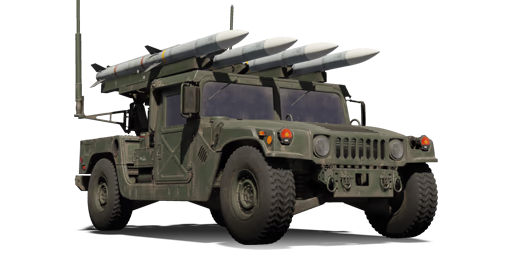

As the MIM-72 became obsolete in the 1990s, the U.S. Armed Forces began searching for a replacement. One option was to combine the M1097 HMMWV vehicle, which was already in use, with the AIM-120 AMRAAM missile to create the SLAMRAAM (Surface-Launched AMRAAM) system for the U.S. Army or the CLAWS (Complementary Low Altitude Weapon System) system for the U.S. Marine Corps. Raytheon carried out the development and production of both variants. The missile armament and detection system, in the form of the AN/MPQ-64 Sentinel radar, were mounted on separate vehicles. This radar was specifically developed for the ground launch of the AIM-120 and was initially used in the Norwegian NASAMS air defense system.
The U.S. Marine Corps conducted the first live-fire tests in 1997, and Raytheon received a contract for further development of the system in 2001. During this phase, the number of missile launch rails increased from four to six, and the ability to mount two AIM-9X missiles was introduced. However, due to cuts in defense spending, the CLAWS contract was canceled in 2006. In 2013, however, the Norwegian Armed Forces adopted an upgraded variant based on the M1152 HMMWV as part of the NASAMS 3 system, designating it NASAMS HML (High Mobility Launcher).
The CLAWS (TEL) was introduced in Update 2.47 "Leviathans" as a composite system. It consists of three components: a surveillance and target designation station (TADS) and two TEL units armed with missiles. The launchers do not require additional research and can be deployed directly in battle via the TADS. The launchers' availability of two missile types—one with active radar homing and the other with infrared guidance—allows the system to fully cover the airspace within a 15 km radius, with no dead zone near the vehicle. The system's high mobility enables it to quickly take up advantageous firing positions or disengage from the enemy. This is especially important because the complete lack of armor and a crew of only two leaves no margin for error; even small caliber machine guns pose a serious threat, not to mention high-explosive shells and artillery fire.


| Ammunition | Type | Armor penetration (mm) at a distance: | |||||
|---|---|---|---|---|---|---|---|
| 10 m | 100 m | 500 m | 1000 m | 1500 m | 2000 m | ||
| AAM | — | — | — | — | — | — | |
| Ammunition | Type | Armor penetration (mm) at a distance: | |||||
|---|---|---|---|---|---|---|---|
| 10 m | 100 m | 500 m | 1000 m | 1500 m | 2000 m | ||
| AAM | — | — | — | — | — | — | |