CLAWS (TADS)
Basic unit

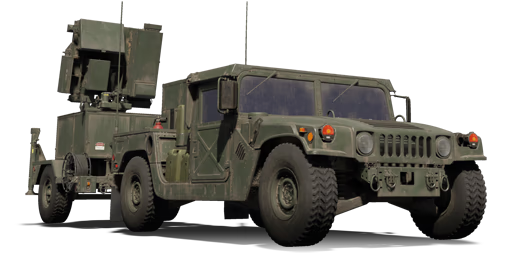



As the MIM-72 became obsolete in the 1990s, the U.S. Armed Forces began searching for a replacement. One option was to combine the M1097 HMMWV vehicle, which was already in use, with the AIM-120 AMRAAM missile to create the SLAMRAAM (Surface-Launched AMRAAM) system for the U.S. Army or the CLAWS (Complementary Low Altitude Weapon System) system for the U.S. Marine Corps. Raytheon carried out the development and production of both variants. The missile armament and detection system, in the form of the AN/MPQ-64 Sentinel radar, were mounted on separate vehicles. This radar was specifically developed for the ground launch of the AIM-120 and was initially used in the Norwegian NASAMS air defense system.
The U.S. Marine Corps conducted the first live-fire tests in 1997, and Raytheon received a contract for further development of the system in 2001. During this phase, the number of missile launch rails increased from four to six, and the ability to mount two AIM-9X missiles was introduced. However, due to cuts in defense spending, the CLAWS contract was canceled in 2006. In 2013, however, the Norwegian Armed Forces adopted an upgraded variant based on the M1152 HMMWV as part of the NASAMS 3 system, designating it NASAMS HML (High Mobility Launcher).
The CLAWS (TADS) was introduced in Update 2.47 "Leviathans", as a composite system. The radar unit is mounted on a trailer. This significantly increases the vehicle's overall length, but allows the main vehicle to be concealed behind a building while only the trailer is exposed. The radar features a high scanning rate and resolution, ensuring continuous airspace monitoring for aircraft and missiles. Its high mobility allows the system to quickly take up advantageous observation positions or disengage from the enemy. This is especially important given the complete lack of armor and the small crew of two, as even small arms fire poses a threat, not to mention high-explosive shells and artillery fire.


Mobility | |
|---|---|
Protection |
|---|
Firepower | |
|---|---|