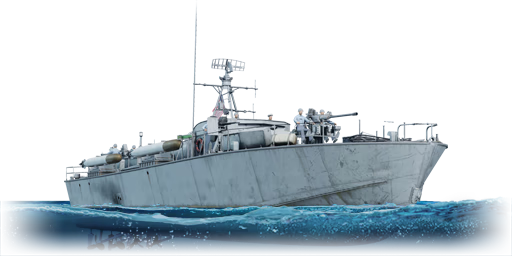
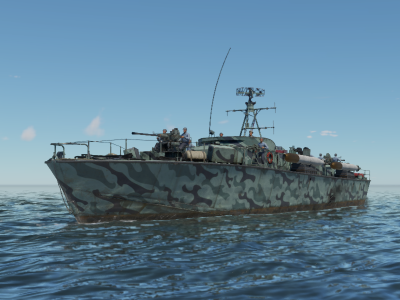
The PT-811 was launched in 1951 as part of a programme to develop fast gunboats for brown water service, based on lessons learnt during the Second World War. Four boats, numbered PT-809 to PT-812, were assigned to Motor Torpedo Squadron 1 and underwent extensive testing at Norfolk. Trials proved PT-811 to be the best in all key characteristics, though all suffered from engine problems and torpedoes being so slow that the boats accidentally ran over them during high-speed operations. Testing concluded in 1959, and PT-811 was struck off the Naval Register in 1960. She returned to service in December 1962 as PTF-2, conducting a shakedown to Norfolk and, in June 1963, leaving for the Philippines, where she was assigned to the SEAL teams operating in Vietnam. She and her sister ship PTF-1 (ex-PT-810) arrived at Da Nang, Vietnam, in April 1964. In August 1965, she was used as a target, being sunk as part of an exercise off the coast of the Hawaiian Islands.
The PT-811 was introduced during Update 1.95 "Northern Wind" as a reward for the 2019 Operation F.R.O.S.T. event. Performance-wise, she is very similar to her half-sister, the PT-810, being slightly smaller and faster, as well as more durable due to her steel hull. Much like the PT-810, the PT-811 features a pair of 40 mm Bofors and twin 20 mm Oerlikon autocannons as her main armament, giving her devastating firepower against simple model ships and aircraft. In addition, she retains the extremely powerful Mk.16 torpedoes that can threaten even battleships. However, even with increased survivability, the PT-811 will regularly face destroyers and large-calibre autocannons, both of which can easily destroy the boat in a few hits.