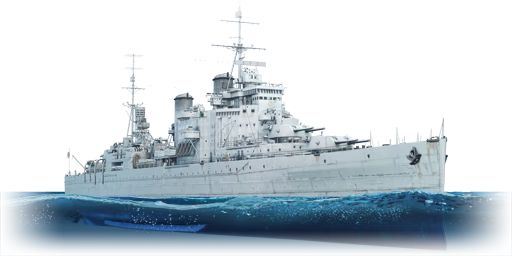
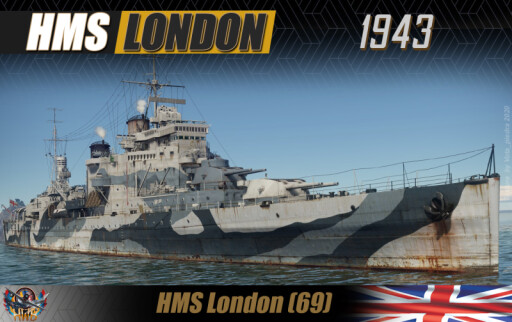
HMS London (C69) was a heavy cruiser in the Royal Navy's fleet. It was the lead ship of the second series of County-class cruisers, known as the London series. Construction began in 1926, it was launched on September 14, 1927, and it was commissioned on January 31, 1929. During the interwar period, it made overseas voyages. The ship participated in the evacuation of refugees from Barcelona during the Spanish Civil War. By the end of the 1930s, the ship underwent extensive modernization and reconstruction.
The cruiser actively participated in World War II. It distinguished itself in the Mediterranean Sea, participated in the pursuit of the Bismarck, and escorted convoys to the USSR. Later, it participated in operations in the Far East as part of the Chinese station, where it saw the end of the war. In 1949, the cruiser was involved in the so-called "Amethyst Incident," in which it was sent to rescue the frigate HMS Amethyst, which had been ambushed on the Yangtze River and suffered serious damage. In the fall of 1949, the ship returned to the UK for an examination to determine its fitness for further service. Due to her poor condition and the fact that she required a large crew, it was decided to sell it for scrap in 1950.
HMS London was introduced in Update 1.97 "Viking Fury" and is depicted in its 1945 modification. It has an excellent anti-aircraft battery and rapid-fire main guns, as well as good ammunition storage protection. However, the crew's location outside the citadel and the poor armor-piercing capabilities of the main guns result in low crew survivability and limited combat effectiveness.






 HMS London