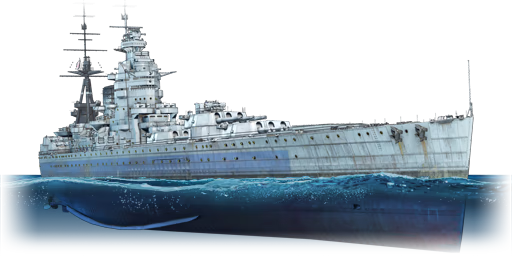
HMS Nelson (28) was the lead ship of her class of two battleships and the first Royal Navy battleship designed under the Washington Naval Treaty. Due to the need to meet treaty restrictions, the ships had a rather unusual design: all main-calibre turrets were concentrated forward, while the secondary gun mounts were positioned aft. These restrictions also led to unconventional propulsion arrangements, with the boiler rooms located aft of the engine rooms. Furthermore, the Nelson-class battleships were the only Royal Navy battleships with just two shafts, as all others from the Dreadnought onwards had four.
HMS Nelson, named after the famous Vice-Admiral Horatio Nelson, was laid down on 28 December 1922, launched on 3 September 1925, and commissioned on 15 August 1927. During the interwar period, the ship primarily conducted overseas cruises, participated in exercises and fleet reviews, and served as the flagship of the Atlantic Fleet (renamed the Home Fleet in March 1932). In September 1931, Nelson’s crew participated in the so-called Invergordon Mutiny, which arose in response to impending pay cuts for sailors. By 17 September, the Admiralty agreed to accommodate the sailors’ demands, and the mutiny ended. The ship spent the first half of World War II in the Mediterranean, covering Allied convoys and supporting ground operations and amphibious landings. In September 1943, the Italian surrender was signed aboard the battleship. In 1944, Nelson provided artillery cover for the Allied landings in Normandy but struck two mines and was seriously damaged. She was subsequently sent to the United States for repairs, where she spent nearly a year.
In July 1945, she was assigned to the Eastern Fleet. Nelson operated along the western coast of the Malayan Peninsula for three months, taking part in Operation Livery. The surrender of Japanese forces on the Malayan Peninsula was also signed aboard the battleship on 2 September 1945, in Georgetown. In November 1945, she returned to the UK and became the flagship of the Home Fleet, but in April 1946 she was converted into a training ship. In October 1947, she was decommissioned and subsequently used as a target ship, before being scrapped on 5 January 1949.
Introduced in Update 2.49 “Tusk Force” in her 1945 configuration, HMS Nelson has good HE rounds for her main battery, with a large TNT filler, though the penetration of her AP shells is rather mediocre. She also boasts a fairly large number of effective anti-aircraft weapons for close and medium range, though her long-range AA is limited due to reliance on a small number of guns firing only HE-TF shells, making them less effective. Her armour and survivability are quite good, but her speed and manoeuvrability prevent her from competing on equal terms with the latest battleships.