
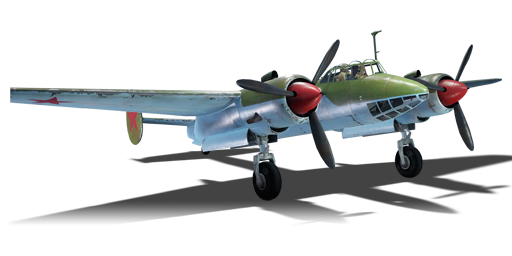
Tu-2 (5)

Following the outbreak of World War II, Tupolev and his team were tasked with developing the "FB" front-line dive bomber. They completed the preliminary design in February 1940, and construction of the first prototype, designated "103" and powered by M-120 engines, began in March. The bomber's first flight took place in January 1941. By March, a second prototype based on the "103U" design was ready. This design featured an additional gunner to defend the upper hemisphere. They subsequently decided to develop this particular variant. In September 1941, they began preparing for its mass production. However, in November, they decided to switch to the "103V" variant with air-cooled M-82 engines since the M-120TK-2 engines were not yet ready.
Production of the aircraft, designated the Tu-2, began in February 1942 at Plant No. 166 in Omsk. However, the first production runs featured mixed armament. Only the sixth series was recognized as the standard version, distinguished by a different canopy configuration and an increased number of blister fairings around the lower gunner’s cockpit. Production ceased in October of that year to make way for the Yak-9 fighter. A total of 80 Tu-2 aircraft equipped with M-82 engines were produced. The Tupolev Design Bureau was assigned Moscow Plant No. 23 to continue work on the aircraft. There, production of an improved version, the Tu-2S, began in 1943.
The Tu-2 (6) has been in the game since the start of the Open Beta Test prior to Update 1.27. For a twin-engine bomber, the Tu-2 has fairly good flight characteristics. While maneuverability is not stellar, it is enough to quickly change flight direction. Its mediocre climb rate is offset by its good horizontal speed and high speed limit, which allow the Tu-2 to escape enemy fighters. Its defensive armament consists of three large-caliber machine guns that only cover the rear hemisphere, but that is more than enough to shoot down an enemy who decides to take a risk. Offensive armament is also pretty strong to be used in some situations. The Tu-2's suspended armament, consisting of various-caliber bombs, makes it an excellent strike aircraft that handles well even when fully loaded.

flaps
flaps
flaps
brake
| Belt | Belt filling | Armor penetration (mm) at a distance: | |||||
|---|---|---|---|---|---|---|---|
| 10 m | 100 m | 500 m | 1000 m | 1500 m | 2000 m | ||
| FI-T/AP-I | 28 | 24 | 14 | 7 | 4 | 2 | |
| FI-T/HEF/AP-I/FI-T | 28 | 24 | 14 | 7 | 4 | 2 | |
| HEF/FI-T/AP-I | 28 | 24 | 14 | 7 | 4 | 2 | |
| FI-T | 4 | 4 | 4 | 4 | 4 | 4 | |
| AP-I/FI-T/AP-I/AP-I | 28 | 24 | 14 | 7 | 4 | 2 | |
| AP-I/HEF/HEF/FI | 28 | 24 | 14 | 7 | 4 | 2 | |
| Belt | Belt filling | Armor penetration (mm) at a distance: | |||||
|---|---|---|---|---|---|---|---|
| 10 m | 100 m | 500 m | 1000 m | 1500 m | 2000 m | ||
| T/AP/AP/IAI | 32 | 30 | 22 | 15 | 11 | 7 | |
| API-T/AP/AP/AP-I(c) | 34 | 32 | 24 | 17 | 12 | 8 | |
| API-T/AP-I | 29 | 27 | 20 | 13 | 8 | 6 | |
| Name | Weight | Slot | ||||
|---|---|---|---|---|---|---|
| 5 × | 258 kg |  | | |||
| 5 × | 211.8 kg |  | | |||
| 252.2 kg |  | | ||||
| 255 kg |  | | ||||
| 508.3 kg |  | | | |||
| 510 kg |  | | | |||
| 1,080 kg |  | | | |||
| 1,012 kg |  | | | |||
| 9 × | 931.5 kg |  | ||||
| 2 × | 504.4 kg |  | ||||
| 2 × | 510 kg |  | ||||
| 4 × | 1,008.8 kg |  | ||||
| 4 × | 1,020 kg |  | ||||



Flight performance | |
|---|---|
Weaponry | |
|---|---|