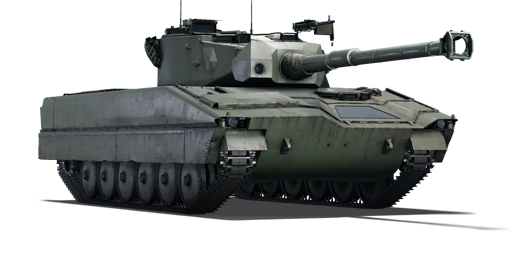
The Ikv 91-105 was a further development based on the Ikv 91 tank destroyer. In 1982, the Ikv 91 was trialled against the AMX-10 PAC 90 by the Indian Army, where it performed well and was highly regarded by the Indians. However, the armament was deemed to be inadequate and, at the request of the Indian Army, AB Hägglunds & Söner started development of what they would later name the Ikv 91-105. The vehicle included a new Low Recoil (LR) 105 mm cannon provided by Rheinmetall, known as the Rh 105-20 (105 mm LR). This cannon featured a much lower recoil force of just 200 kN, compared to the standard 105 mm L7's 600 kN. The commander and gunner also received new fire control systems, with IR night vision devices provided by AGA/BAAB (AGA/Bofors Aerotronics AB). While India considered the tank, the vehicle was never adopted. The Swedish Army also had doubts about the chassis' ability to handle the new cannon, and instead used the Strv 121/122 and Strf 90 to fulfil the role of the Ikv 91 in the following years.
Introduced in Update "Ixwa Strike", the Ikv 91-105 has access to a set of very decent characteristics at its BR. For example, while it may lack advanced fire control systems such as thermal sights, it does have very good mobility, making it a very lethal light tank if it tries to flank the main enemy columns. Its best round, the slpprj m/80, has good penetration values, and coupled with its two-axis stabiliser and a laser rangefinder, it will be one of the first to shoot if it acquires a target quickly enough. Its gun depression is adequate for engaging targets over hills and mountains. It should be noted that the reverse speed is not great, and it should use its smoke launchers when reversing to avoid getting stuck in a bad position.