
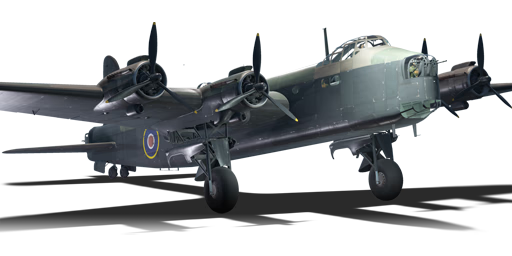
Stirling B Mk III



Following complaints about the poor flight performance of the Short Stirling Mk I, Short Brothers developed an up-engined variant of the bomber, designated Stirling B Mk III. While largely similar to the Mk I, the Mk III’s key difference is the supercharged Bristol Hercules XVI engines with 1,635 hp output, which improved its top speed and high altitude characteristics. While the Mk III was well-received by pilots after its introduction in 1943, its days were already numbered; due to a pair of structural dividers that ran down the middle of the bombing bay, the Stirling could not carry bombs heavier than 2,000 lb. This, along with the decision to focus production on the more capable Halifaxes and Lancasters, resulted in the Stirling being phased out of active duty in 1944, with the remaining airframes converted for secondary roles, such as transport and glider tug. In total, 2,091 Stirling Mk III were produced.
The Stirling B Mk III was introduced in Update 1.55 "Royal Armour". Compared to the early Mk I version, the Mk III features a considerable improvement in terms of flight performance. While the top speed and handling remain poor, the Mk III is equipped with supercharged engines that allow it to climb higher and maintain its speed at high altitudes. Other than this, the Stirling Mk III is largely identical to its predecessor. While the Stirling retains the same heavy payload that can effectively deal with bases and ground targets, its massive yet fragile airframe will become an easy target for any fighters it flies into. This is further exacerbated by the fact that it retains the same weak defensive armaments that are ineffective at fending off incoming attacks.

flaps
flaps
flaps
brake
| Belt | Belt filling | Armor penetration (mm) at a distance: | |||||
|---|---|---|---|---|---|---|---|
| 10 m | 100 m | 500 m | 1000 m | 1500 m | 2000 m | ||
| T/AP/AP-I/Ball/Ball/I | 13 | 12 | 7 | 3 | 2 | 0 | |
| T/AP/AP/AP | 13 | 12 | 7 | 3 | 2 | 0 | |
| T/AP-I/AP-I/AP-I | 13 | 12 | 7 | 3 | 2 | 0 | |
| Belt | Belt filling | Armor penetration (mm) at a distance: | |||||
|---|---|---|---|---|---|---|---|
| 10 m | 100 m | 500 m | 1000 m | 1500 m | 2000 m | ||
| T/AP/AP-I/Ball/Ball/I | 13 | 12 | 7 | 3 | 2 | 0 | |
| T/AP/AP/AP | 13 | 12 | 7 | 3 | 2 | 0 | |
| T/AP-I/AP-I/AP-I | 13 | 12 | 7 | 3 | 2 | 0 | |


 Stirling B Mk III
Flight performance | |
|---|---|
Survivability |
|---|
Weaponry | |
|---|---|