
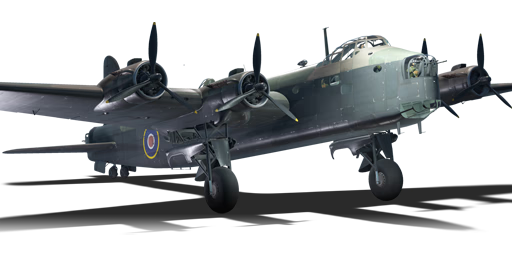
Stirling B Mk I



While the Royal Air Force was mainly focused on the development of a twin-engined medium bomber during the 1930s, developments of the four-engined heavy bombers in the United States and the Soviet Union had caught the British attention due to improvements in terms of range and reliability. Therefore, in 1936, the British Air Ministry issued Specification B. 12/36, calling for a four-engined heavy bomber with long range and large payload capacity. Of the three designs submitted, only the Short Stirling of Short Brothers made it to production. After the prototype made its first flight on 14 May 1939, the Stirling entered service with the RAF on 7 May 1940, being the first four-engined bomber to enter service during wartime. While the Stirling’s design met its specification criteria for the RAF, it was outclassed in terms of performance by its contemporaries, the Handley Page Halifax and the Avro Lancaster, due to its significantly larger size compared to both aircraft (whose designs originated from twin-engined bombers), resulting in significantly lower top speed and flight ceiling, as well as being difficult to take off and land. Nevertheless, the Stirling would serve with the RAF as one of the main heavy bombers until the end of the war. In total, 2,371 Stirlings of all variants were built and served with the RAF until 1946, seeing further foreign service until 1951 with the Egyptian Air Force.
The Stirling B Mk I was the first production variant of the Short Stirling family. It was powered by four Bristol Hercules XI engines with 1,590 hp. While powerful, the lack of a supercharger significantly limited the power output of the engines at high altitude. In total, 708 Stirling Mk Is were built before it was eventually phased out by the improved Mk III in 1943.
The Stirling B Mk I was introduced in Update 1.55 "Royal Armour". Compared to its predecessor, the Halifax Mk IIIa, the Stirling may be considered a downgrade due to its significantly slower top speed and much more sluggish handling. Despite its massive airframe, the Stirling has very poor survivability due to weak airframe strength and it has a tendency to catch fire from a hit from autocannons. This is not helped by the fact that it is only defended by small-calibre machine guns that struggle to handle any pursuing fighters. On the bright side, as with the other “big 3” British heavy bombers, the Stirling still offers a massive payload of up to 6.4 tons in the form of 27 × 500 lb bombs, allowing it to take out multiple bases or perform carpet bombing with ease.

flaps
flaps
flaps
brake
| Belt | Belt filling | Armor penetration (mm) at a distance: | |||||
|---|---|---|---|---|---|---|---|
| 10 m | 100 m | 500 m | 1000 m | 1500 m | 2000 m | ||
| T/AP/AP-I/Ball/Ball/I | 13 | 12 | 7 | 3 | 2 | 0 | |
| T/AP/AP/AP | 13 | 12 | 7 | 3 | 2 | 0 | |
| T/AP-I/AP-I/AP-I | 13 | 12 | 7 | 3 | 2 | 0 | |
| Belt | Belt filling | Armor penetration (mm) at a distance: | |||||
|---|---|---|---|---|---|---|---|
| 10 m | 100 m | 500 m | 1000 m | 1500 m | 2000 m | ||
| T/AP/AP-I/Ball/Ball/I | 13 | 12 | 7 | 3 | 2 | 0 | |
| T/AP/AP/AP | 13 | 12 | 7 | 3 | 2 | 0 | |
| T/AP-I/AP-I/AP-I | 13 | 12 | 7 | 3 | 2 | 0 | |
| Belt | Belt filling | Armor penetration (mm) at a distance: | |||||
|---|---|---|---|---|---|---|---|
| 10 m | 100 m | 500 m | 1000 m | 1500 m | 2000 m | ||
| T/AP/AP-I/Ball/Ball/I | 13 | 12 | 7 | 3 | 2 | 0 | |
| T/AP/AP/AP | 13 | 12 | 7 | 3 | 2 | 0 | |
| T/AP-I/AP-I/AP-I | 13 | 12 | 7 | 3 | 2 | 0 | |


Flight performance | |
|---|---|
Survivability |
|---|
Weaponry | |
|---|---|