
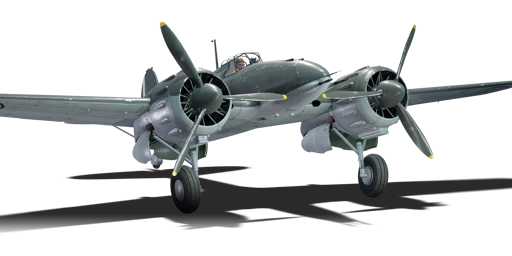



In the second half of the 1930s, the Regia Aeronautica expressed interest in a twin-engine fighter capable of escorting Allied bombers and intercepting enemy aircraft. Industrie Meccaniche Aeronautiche Meridionali (IMAM) was then tasked with designing such an aircraft. The first version of the heavy fighter, the Ro.57, appeared in early 1939. Despite its decent speed, which surpassed that of all other single-engine Italian fighters, the aircraft proved to be mediocre. This led the military to reject it. For this reason, IMAM proposed redesigning the aircraft as a ground-attack plane with two 20-mm cannons, air brakes, and bomb racks. The new variant, the Ro.57 bis, also known as the Ro.57 Quadriarma, first flew in 1941. However, during testing, it demonstrated even worse flight characteristics than the original Ro.57. Nevertheless, due to the failure of another ground-attack aircraft project, the Breda Ba.88, the Regia Aeronautica placed an order for 200 Ro.57 bis, later reducing it to 110. By the time Italy surrendered, IMAM had only assembled 75 Ro.57 bis aircraft, which never saw action and were decommissioned by the end of 1943.
The Ro.57 Quadriarma has been introduced as one of the rewards for the 2020 “Operation W.I.N.T.E.R” event. The Ro.57 Quadriarma's flight characteristics differ significantly from those of other twin-engine fighters. While it lags behind its competitors in climb rate and especially speed, it rivals some single-engine fighters in maneuverability. However, its modest ammunition load and questionable machine gun performance will significantly hinder players in aerial combat. In addition to aerial combat, the Ro.57 Quadriarma can prove useful in ground attack thanks to its ability to carry bombs up to 500 kg.

flaps
flaps
flaps
brake
| Belt | Belt filling | Armor penetration (mm) at a distance: | |||||
|---|---|---|---|---|---|---|---|
| 10 m | 100 m | 500 m | 1000 m | 1500 m | 2000 m | ||
| PT/HEI/AP/HEI-T | 38 | 34 | 23 | 14 | 9 | 5 | |
| AP-T/HEI/AP-T/HEI | 38 | 34 | 23 | 14 | 9 | 5 | |
| AP-T/AP/AP-T/HEI/AP-T | 38 | 34 | 23 | 14 | 9 | 5 | |
| AP-T/HEI-T | 38 | 34 | 23 | 14 | 9 | 5 | |
| AP/HEI | 38 | 34 | 23 | 14 | 9 | 5 | |
| Belt | Belt filling | Armor penetration (mm) at a distance: | |||||
|---|---|---|---|---|---|---|---|
| 10 m | 100 m | 500 m | 1000 m | 1500 m | 2000 m | ||
| T/Ball/Ball/I/AP | 21 | 19 | 12 | 7 | 4 | 2 | |
| AP/AP-I/HEF/API-T/I | 21 | 19 | 12 | 7 | 4 | 3 | |
| API-T/AP-I/HEF | 21 | 19 | 12 | 7 | 4 | 3 | |
| API-T | 21 | 19 | 12 | 7 | 4 | 3 | |
| AP-I/AP-I/HEF/HEF | 20 | 18 | 11 | 6 | 4 | 2 | |
| Name | Weight | Slot | ||||||
|---|---|---|---|---|---|---|---|---|
| 58 kg |  | | ||||||
| 109 kg |  | | ||||||
| 100 kg | | | ||||||
| 151.1 kg |  | | ||||||
| 259 kg |  | |||||||
| 508 kg |  | |||||||
| 821.6 kg |  | |||||||
| 651.5 kg |  | |||||||


 2 x (50 / 175 / 270) %
2 x 124 %
2 x (50 / 175 / 270) %
2 x 124 %
Flight performance | |
|---|---|
Survivability |
|---|
Weaponry | |||
|---|---|---|---|