
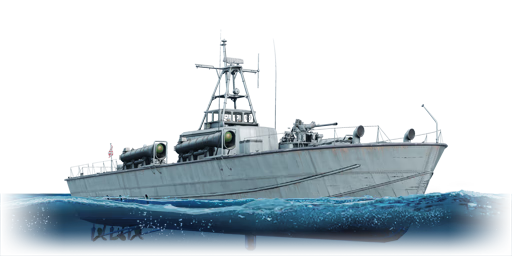
PT-808



The PT-7-class, PT-8 (PT-808) was an experimental Japanese torpedo boat developed as an enlarged derivative of the PT-3-class. Following trials of the earlier PT-1, PT-3 and PT-5 boats, the JMSDF found them too small for their intended role, while the sonar dome created considerable resistance at high speed. The PT-7 therefore featured a larger aluminium-alloy hull and improved sonar dome. Two boats were built at the Mitsubishi shipyard, with PT-808 completed in 1958. Both were initially powered by three diesel engines, although PT-807 was later fitted with a gas turbine in 1968 to test propulsion concepts for the later PT-11-class. PT-808 remained in service until 1974.
The PT-808 was introduced in Update 2.29 "Sons of Attila". It is armed with two 40 mm Bofors L/60 autocannons, providing strong firepower against other small vessels, while its relatively large hull and modest speed make it less suited to hit-and-run attacks. Its four torpedoes are relatively weak, limiting its effectiveness against larger vessels and making its 40 mm guns the primary means of engaging smaller targets.

| Belt | Belt filling | Armor penetration (mm) at a distance: | |||||
|---|---|---|---|---|---|---|---|
| 10 m | 100 m | 500 m | 1000 m | 1500 m | 2000 m | ||
| AP-T/HEFI-T | 81 | 78 | 69 | 61 | 55 | 50 | |
| AP-T/AP-T/AP-T/HEFI-T | 81 | 78 | 69 | 61 | 55 | 50 | |
| HEFI-T/HEFI-T/HEFI-T/AP-T | 81 | 78 | 69 | 61 | 55 | 50 | |
8 × 7.2 in T37 bomb


Seakeeping | |
|---|---|
Unsinkability | |
|---|---|
Firepower | |
|---|---|