In 1934, with the need for newer battleships to increase the offensive capabilities of the Royal Italian Navy, the Littorio-class battleship was chosen. Three were built (Littorio, Vittorio Veneto and Roma) and one remained unfinished (Impero). The third ship of the Littorio class was Roma, laid down on 18 September 1938, launched on 9 July 1940, and entering service on 14 June 1942 with the IX Divisione Navale. During her service, the ship never engaged in combat with other battleships, but underwent many refits. During the redeployment of Italian naval forces from La Spezia to other locations on 9 September 1943 — the day after the armistice — Roma, which was heading to Algeria to reunite with Allied units, was attacked by German bombers using the new PC 1400 X bomb, one of the first guided bombs. Two of these struck RN Roma: the first passed through the ship, perforating the three armoured decks beneath the hull; the second was fatal, striking near the cannon charges and causing a detonation that sank the ship.
RN Roma was introduced in Update "Leviathans" in her early 1943 refit. The most notable feature of this ship is her main armament of three triple turrets with 381 mm guns, which offer some of the best penetrating shells, but are balanced by a terrible reload time. The dispersion also makes them inaccurate at long range against enemy ships. The armour is adequate, but only effective against other battleships beyond 16 km. She has mediocre manoeuvrability and acceleration.

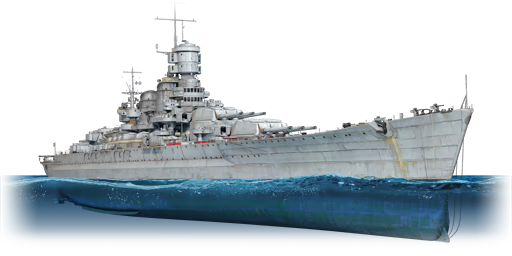




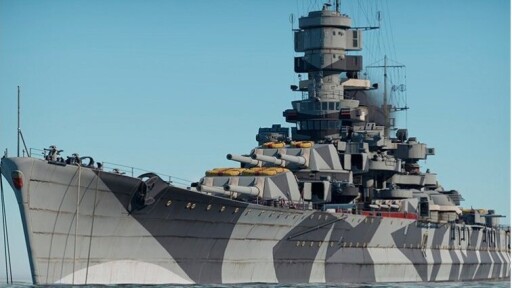



 RN Roma