
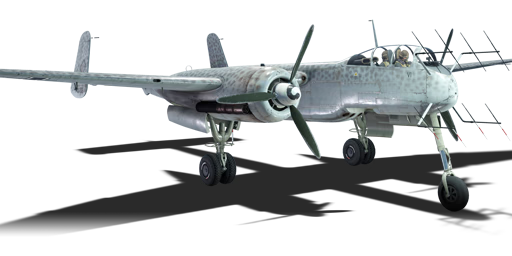


After leaving Messerschmitt for Heinkel, engineer Robert Lusser started working on a high-altitude bomber equipped with a catapult, tricycle landing gear, and a pressurized cockpit. The project was designated P.1055, but in August 1940, the German Aviation Ministry (RLM) rejected it as too risky. The same fate befell the P.1056 night fighter project, and Heinkel dismissed Lusser immediately upon receiving the response. However, the projects were not abandoned. In 1941, Josef Kammhuber, commander of the night fighter forces, requested a new night fighter. Heinkel quickly redesigned the P.1055 bomber into the P.1060 night fighter and planned to use DB 603 engines instead of the originally planned DB 610s. Due to the characteristics of the prototype engines, the wingspan had to be made quite small.
Henkel named the new aircraft the He 219 and built a prototype with his own funding, confident in its success. However, in January 1942, the RLM rejected the aircraft again in favor of the modernized Ju 88 and Me 210. Nevertheless, the prototype made its maiden flight on November 6, 1942. It impressed Kammhuber so much that he immediately requested the start of production despite protests from the RLM. By the summer of 1943, nine prototypes with various design changes were ready. At the same time, pre-production of the He 219 A-0 with DB 603A engines began. Several prototypes and planned designs followed, but only the A-2, which had enlarged fuel tanks, and the A-7, which had more powerful DB 603E engines and expanded weaponry options, went into mass production. A total of 210 aircraft were planned, but due to lost documents, the exact number completed by the end of the war in Europe is unknown.
The He 219 A-7 was introduced in Update 1.59 "Flaming Arrows". Created by user Daniil "Joy_Division__" Zaitsev, it was added to the game through the Revenue Share program. This heavy fighter has powerful main armament, a good climb rate, and high survivability. It also stands out for its radar. However, it lacks defensive armament, and its maneuverability and top speed are mediocre. Additionally, the ballistics of its offensive armament are quite complex.

flaps
flaps
flaps
brake
| Belt | Belt filling | Armor penetration (mm) at a distance: | |||||
|---|---|---|---|---|---|---|---|
| 10 m | 100 m | 500 m | 1000 m | 1500 m | 2000 m | ||
| HEI-T/I | 8 | 7 | 4 | 2 | 1 | 1 | |
| HEI-T/HEI-T/HEI-T/HEF-I | 4 | 4 | 4 | 4 | 4 | 4 | |
| HEI-T/HEI-T/HEI-T | 4 | 4 | 4 | 4 | 4 | 4 | |
| SAPHEI-T | 13 | 12 | 9 | 6 | 4 | 3 | |
| HEI | 4 | 4 | 4 | 4 | 4 | 4 | |
| Belt | Belt filling | Armor penetration (mm) at a distance: | |||||
|---|---|---|---|---|---|---|---|
| 10 m | 100 m | 500 m | 1000 m | 1500 m | 2000 m | ||
| HEI-T/SAPHEI-T/AP-I | 58 | 55 | 44 | 33 | 25 | 19 | |
| HVAP-T | 77 | 74 | 61 | 47 | 37 | 29 | |
| SAPHEI-T/SAPHEI-T | 38 | 36 | 28 | 20 | 15 | 11 | |
| HEI-T/HEI-T/HEI-T/SAPHEI-T | 38 | 36 | 28 | 20 | 15 | 11 | |
| AP-I | 58 | 55 | 44 | 33 | 25 | 19 | |
| Belt | Belt filling | Armor penetration (mm) at a distance: | |||||
|---|---|---|---|---|---|---|---|
| 10 m | 100 m | 500 m | 1000 m | 1500 m | 2000 m | ||
| IT/IT/APHE/HEI | 20 | 18 | 10 | 5 | 4 | 4 | |
| IT/HEI/HEI/AP-I | 27 | 24 | 14 | 7 | 3 | 2 | |
| AP-I/HEI/HEI/HEI/HEI/IT | 27 | 24 | 14 | 7 | 3 | 2 | |
| APHE/APHE/APHE/IT | 20 | 18 | 10 | 5 | 4 | 4 | |
| FI-T/FI-T/FI-T/IT/IT | 10 | 9 | 5 | 3 | 2 | 1 | |
| HEI/HEI/HEI/APHE/AP-I | 27 | 24 | 14 | 7 | 3 | 2 | |


 2 x (90 / 155 / 415) %
2 x 160 %
2 x (90 / 155 / 415) %
2 x 160 %
Flight performance | |
|---|---|
Survivability |
|---|
Weaponry | |
|---|---|