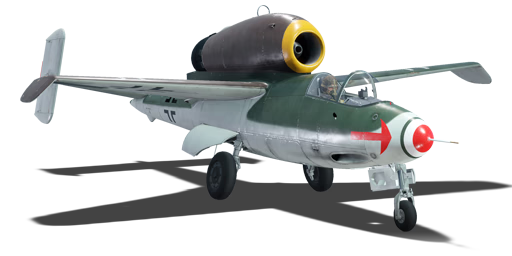
He 162 A-1

The He 162 A-1 Salamander was a German jet fighter developed during the final stages of World War II. As the Allies gained air superiority in 1944, the Luftwaffe sought a solution through the Volksjäger program. This program called for a simple, easy-to-produce, easy-to-operate single-engine jet fighter that could still challenge Allied aircraft. Heinkel's winning design was known as the "Salamander" and the "Spatz" before receiving the designation He 162. Remarkably, the first prototype flew only 74 days after the competition winner was announced. Several variants were developed with different engines and armament configurations. The A-1 version was equipped with two MK 108 cannons, each carrying 50 rounds, and was powered by a BMW 003 engine. Although the aircraft was well suited for mass production under conditions of limited resources and constant bombing of German factories, the rushed development process resulted in numerous reliability issues, further aggravated by shortages of fuel and spare parts. Only about 120 aircraft were completed, and only a few of them saw combat during the last two months of the war.
The He 162 A-1 first became obtainable as an event reward during War Thunder’s 5th anniversary celebration. Similar to the He 162 A-2, it has low engine power and an engine that overheats quickly at maximum thrust. Its climb rate is unimpressive; however, its high top speed in level flight allows it to outrun piston-engined aircraft, even after a dive. The He 162 A-1 excels in hit-and-run attacks, relying on speed and making brief corrections to its aim. Despite this, its lightweight construction gives it respectable maneuverability, allowing it to hold its own in one-on-one dogfights when necessary. The aircraft’s armament is somewhat controversial; it carries only two MK 108 cannons. However, a single hit is often enough to destroy even large, multi-engine aircraft. With only 50 rounds per gun and the low muzzle velocity of the ammunition, it is difficult to shoot. The He 162 A-1 carries no suspended armament, which limits its usefulness in mixed battles to intercepting enemy aircraft.

flaps
flaps
flaps
brake
| Belt | Belt filling | Armor penetration (mm) at a distance: | |||||
|---|---|---|---|---|---|---|---|
| 10 m | 100 m | 500 m | 1000 m | 1500 m | 2000 m | ||
| HEI-T/I | 8 | 7 | 4 | 2 | 1 | 1 | |
| HEI-T/HEI-T/HEI-T/HEF-I | 4 | 4 | 4 | 4 | 4 | 4 | |
| HEI-T/HEI-T/HEI-T | 4 | 4 | 4 | 4 | 4 | 4 | |
| SAPHEI-T | 13 | 12 | 9 | 6 | 4 | 3 | |
| HEI | 4 | 4 | 4 | 4 | 4 | 4 | |



Flight performance | |
|---|---|
Survivability |
|---|
Weaponry |
|---|