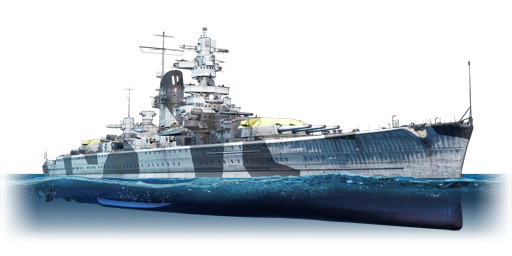
The Admiral Scheer was the second ship of the Deutschland-class cruisers, commonly referred to as the "pocket battleships" because of their large guns and small size. They were designed to comply with the Treaty of Versailles, which limited the naval power of Germany after World War I. Each successive ship of the class was built with increased armour as a result of the easing of the tonnage restrictions imposed on Germany over time, with Admiral Scheer having more armour than Deutschland but less than Admiral Graf Spee.
Admiral Scheer was laid down on 25 June 1931 at the Reichsmarinewerft (later Kriegsmarinewerft) shipyard in Wilhelmshaven, launched on 1 April 1933, and commissioned on 12 November 1934. After her deployment in the Spanish Civil War in 1936, Admiral Scheer was assigned to convoy raiding duties at the outbreak of World War II in the Atlantic Ocean. During this time, she sank 113,223 GRT of shipping, making her the most successful capital ship raider of the war. She was recalled to Europe in 1942 to intercept Allied and Soviet convoys, including taking part in Operation Wunderland in an attempt to block convoys heading to Siberia, and was later relegated to training duties from 1943 to 1944. As the situation worsened, Admiral Scheer was brought back into active service in 1945 in an attempt to halt Soviet advances, though the lack of maintenance during her dormancy necessitated repairs. On the night of 9 April 1945, while Admiral Scheer was docked at the Deutsche Werke shipyard in Kiel, a raid by over 300 RAF aircraft struck the harbour, during which the ship was hit by bombs and capsized in the harbour. Her hull was partially scrapped after the war, although the harbour where she capsized was later filled in during renovations. She remains buried to this day beneath what is now a car park near the Bundesmarine Naval Arsenal in Kiel.
Introduced in Update 2.57 "Heavy Cavalry", Admiral Scheer is very similar to her sister ship Admiral Graf Spee, with the main difference being her noticeably weaker armour. She lives up to her "pocket battleship" moniker thanks to her slow but hard-hitting firepower. Like her sister ship, Admiral Scheer primarily excels at long-range engagements, capable of outranging any other cruiser at her rank. However, due to her weaker armour, she is more prone to taking damage from armour-piercing shells, especially at closer ranges.