
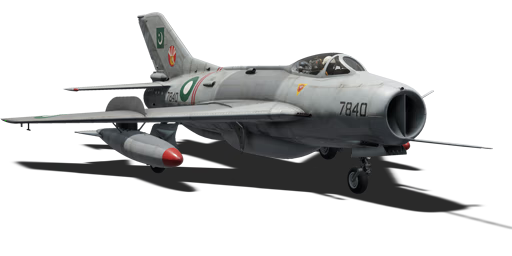
▄F-6C


The J-6A (Chinese: 歼-6A型飞机) was a Chinese licence-produced version of the MiG-19. The J-6 had a successful export career as the F-6, and by far its largest foreign operator was Pakistan.
In the wake of suffering heavy losses to India in the 1965 India–Pakistan War, Pakistan began searching for a new fighter aircraft. They selected the F-6C from China and placed an initial order for 72 aircraft, the first 60 of which were donated by China free of cost as a show of goodwill, with the first 12 being delivered on 30 December under absolute secrecy. By the end of deliveries in 1980, Pakistan's order had ballooned to a combined 260 F-6 fighter aircraft and FT-6 trainers. These aircraft were used as air defence and close air support aircraft, and proved very effective in the 1971 India–Pakistan War. In Pakistani service, they saw over 140 modifications in total. Notable were the fitting of AIM-9 Sidewinder missiles, underwing fuel tanks, a repositioned drogue chute, the Martin-Baker Mk. 10L ejection seat, an IFF system, and an underbelly conformal fuel tank nicknamed the "Gondola". Pakistan continued to further upgrade it throughout the 1990s. To facilitate these overhauls, in 1980 the Pakistan Air Force opened the F6 Rebuilding Factory (Urdu:دوبارہ تعمیر کرنے والی فیکٹری F6), today part of the Pakistan Aeronautical Complex (PAC) (Urdu: پاکستان ایروناٹیکل کمپلیکس).
The F-6C was introduced as a reward for the 2026 "Lion of Peshwar" event in its August 1976 configuration. It plays similarly to the J-6A, with powerful engines, good acceleration, and a good turn rate before it compresses. Generally, it is a fantastic energy fighter. However, it is significantly more versatile in aerial engagements because of its AIM-9P missiles, which are especially potent against aircraft without countermeasures, which the F-6C will often face. However, it still suffers from a lack of countermeasures and its tendency to compress heavily at transonic speeds, where its turns become extremely sluggish and it struggles to pull out of dives, as well as still highly limited gun ammunition.

flaps
flaps
flaps
brake
| Belt | Belt filling | Armor penetration (mm) at a distance: | |||||
|---|---|---|---|---|---|---|---|
| 10 m | 100 m | 500 m | 1000 m | 1500 m | 2000 m | ||
| HEF-I/HEFI-T/APHE | 40 | 39 | 34 | 28 | 23 | 19 | |
| HEFI-T/APHE/APHE/APHE | 40 | 39 | 34 | 28 | 23 | 19 | |
| HEF-I/HEFI-T/HEFI-T | 6 | 6 | 5 | 4 | 4 | 3 | |
| Name | Weight | Slot | ||||||
|---|---|---|---|---|---|---|---|---|
| 76.9 kg |  | | ||||||
| 8 × | 95.1 kg |  | | | | |||
| 140 kg |  | | ||||||
| 236 kg |  | | ||||||
| Drop tank (760 liters) | 145 kg |  | | |||||
| Conformal fuel tank (1140 liters) | 160 kg |  | ||||||



Flight performance | |
|---|---|
Survivability |
|---|
Weaponry | ||
|---|---|---|