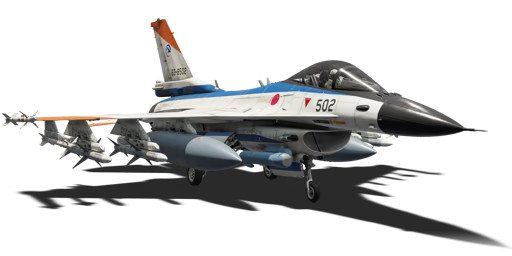
F-2A ADTW


In 1981, the Japan Air Self-Defense Force (JASDF) concluded that the Mitsubishi F-1 had become obsolete and required a replacement that would be entirely produced in Japan. In 1985, the program began, and the Japanese first approached the United States for assistance in developing an aircraft based on the F-16 or F/A-18. The program was designated the Mitsubishi FS-X. Japan covered 60% of the costs, while the United States covered 40%. The Japanese military selected an enlarged F-16 design that had previously been rejected by the U.S. Air Force as a base and equipped it with their own modern electronics. Initially, two variants were planned: the single-seat F-2A and the two-seat F-2B. However, due to design issues, the first prototype flight did not take place until October 7, 1999, and its entry into service was delayed until 2000. The last production aircraft, one of 94, was delivered on September 27, 2011. Ultimately, the F-2 replaced the aging F-4EJ.
Despite its external similarity to the F-16, the fighter has several differences, including larger dimensions, a different internal structure, an enlarged tail section, a different avionics suite, an active electronically scanned array radar, different canopy glazing, and Japanese weapon systems. While the production aircraft were assigned to operational units, four prototypes were assigned to the Air Development and Test Wing (ADTW). The ADTW is responsible for pre-operational testing, equipment evaluation for the JASDF, and air combat training development.
The F-2A ADTW was introduced in Update 2.47 "Leviathans". While the F-2A is theoretically more maneuverable than the F-16, it loses energy quicker due to its larger wing and can be outmatched in prolonged one-on-one engagements. It is also equipped with excellent AAM-3 infrared missiles. However, the Japanese variant lacks a helmet-mounted sight. Compared to the standard F-2A, it is also deprived of AAM-4 missiles and is limited to AIM-7M missiles.

flaps
flaps
flaps
brake
| Belt | Belt filling | Armor penetration (mm) at a distance: | |||||
|---|---|---|---|---|---|---|---|
| 10 m | 100 m | 500 m | 1000 m | 1500 m | 2000 m | ||
| HEF-I/API-T/AP-I | 40 | 36 | 21 | 11 | 6 | 3 | |
| HEF-I/HEF-I/API-T/HEF-I/HEF-I/AP-I | 40 | 36 | 21 | 11 | 6 | 3 | |
| API-T/AP-I/AP-I/AP-I/HEF-I | 40 | 36 | 21 | 11 | 6 | 3 | |
| HEF-I/AP-I/AP-I | 40 | 36 | 21 | 11 | 6 | 3 | |
| Name | Weight | Slot | ||||||||||||
|---|---|---|---|---|---|---|---|---|---|---|---|---|---|---|
| 84.5 kg |  | | | | ||||||||||
| 84.5 kg |  | | | | ||||||||||
| 91 kg |  | | | | ||||||||||
| 231.3 kg |  | | | | ||||||||||
| 19 × | 229.6 kg |  | | | | | | |||||||
| 4 × | 280.3 kg |  | | | | | | |||||||
| 3 × | 722.7 kg | 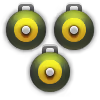 | | | | | | |||||||
| 893.6 kg | 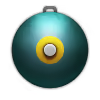 | | | | | | ||||||||
| 3 × | 762 kg | 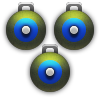 | | | | | | |||||||
| 893.6 kg | 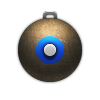 | | | | | | ||||||||
| 2 × | 506.2 kg |  | | | | |||||||||
| 893.6 kg |  | | | | ||||||||||
| 987 kg |  | | | | ||||||||||
| 2 × | 579.4 kg |  | | | | |||||||||
| 600 kg |  | | | | | | ||||||||
| 528 kg |  | | | | | | ||||||||
| 940 kg |  | | | | ||||||||||
| Drop tank (600 gal.) | 150 kg |  | | |||||||||||
| Drop tank (300 gal.) | 100 kg | | ||||||||||||
| J/AAQ-2 targeting pod | 145 kg |  | ||||||||||||


 2 x (95 / 320 / 500) %
2 x 256 %
2 x (95 / 320 / 500) %
2 x 256 %
Flight performance | |
|---|---|
Survivability |
|---|
Weaponry | ||
|---|---|---|