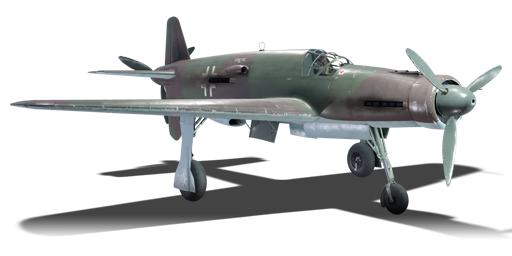
Do 335 A-0



Long before World War II, Dornier's founder and chief engineer, Claude Dornier, believed in the concept of push-pull aircraft, as this design offered significantly less drag and profile compared to the traditional layout. His vision culminated in the Dornier Do 335. Nicknamed Pfeil (arrow), the Do 335 originated from a design specification issued by the RLM in 1942, calling for a single-seat Schnellbomber with speed as the priority. Due to its potential high speed, however, the RLM ordered Dornier to modify the design into a fighter-bomber role in autumn that year, causing a delay in production. The first prototype of the Do 335 flew on 26 October 1943 and was expected to enter production in March 1946. However, as the tide of war turned against Germany, Hitler personally ordered the RLM to prioritise the Do 335's production on 23 May 1944 and assigned it to the Emergency Fighter Programme, resulting in yet another delay. As a result, only 37 of the type were built, and they saw limited service towards the end of the war.
The Do 335 A-0 was the pre-serial production variant of the Dornier 335. Delivered in May 1944, the A-0's design was modified per Hitler's order to be converted into a bomber interceptor as part of the Emergency Fighter Programme. The A-0 saw limited service during the last days of the war in Europe. While most Allied fighters were unable to keep up with its high top speed, it had very little impact on the overall war effort. In total, 10 of the A-0 variant were built, with only one surviving to this day and being on display at the National Air and Space Museum in the United States.
The Do 335 A-0 was introduced in Update 1.57 "Battle March". Compared to its later variant, the A-1, this version of the Pfeil leans more towards the role of a high-speed interceptor, exchanging the bomb payload for an option to replace the pair of 15 mm machine guns with 20 mm guns. Much like the A-1 variant, the A-0 relies heavily on its high top speed and firepower to compensate for its lacklustre handling and survivability. Although it does not have a bomb payload, the A-0 is still effective in a close air support role, as its 30 mm gun has access to powerful AP belts that can penetrate most tanks with ease.

flaps
flaps
flaps
brake
| Belt | Belt filling | Armor penetration (mm) at a distance: | |||||
|---|---|---|---|---|---|---|---|
| 10 m | 100 m | 500 m | 1000 m | 1500 m | 2000 m | ||
| HEI-T/SAPHEI-T/AP-I | 58 | 55 | 44 | 33 | 25 | 19 | |
| HVAP-T | 77 | 74 | 61 | 47 | 37 | 29 | |
| SAPHEI-T/SAPHEI-T | 38 | 36 | 28 | 20 | 15 | 11 | |
| HEI-T/HEI-T/HEI-T/SAPHEI-T | 38 | 36 | 28 | 20 | 15 | 11 | |
| AP-I | 58 | 55 | 44 | 33 | 25 | 19 | |


 Do 335 A-0
Flight performance | |
|---|---|
Survivability |
|---|
Weaponry | ||
|---|---|---|