
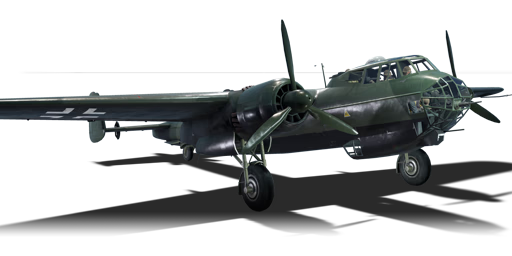
Do 217 E-4



The Dornier 217 was a German WWII-era medium bomber, developed as a direct descendant of the previous Do 17 medium bomber series. Unlike the previous Do 217 E-2, the Do 217 E-4 was equipped with the BMW 801L engines. The crew of five was sitting inside the partially glazed canopy. Compared to the Do 217 E-2 the defensive armament was strengthened as the forward-firing 7.92 mm MG 15 machine gun was replaced by the 20 mm MG FF/M cannon. The offensive armament remained the same with a single MG 151 15 mm cannon as well as 4000 kg of bombs either in the bomb bay or on external racks under the wings. The first Do 217s appeared in March 1941 on the Western front and at the end of the year also on the Eastern one. The Dorniers served in frontline service until the end of the war.
The Do 217 E-4 was introduced in Update 1.29 together with the other planes of the Dornier 217 family. The Do 217 is faster than most of the other bombers it will meet in battle, being capable of taking out up to four bombing points when utilizing the Flamm C250 incendiary bombs or up to four bases utilizing the four SC 1000 bombs, depending on the maximal battle rating of the said match. Do 217 E is also very capable CAS due to its heavy bomb load as the powerful 1000 kg bombs contain 600 kg of TNT eq. and have a wide destruction radius. Do 217 can also be used in naval battles as it comes equipped with a pair of F5W torpedoes with a 3 km range and 300 kg TNT eq. The forward fixed 20 mm cannon can be utilized against enemy bombers or unsuspecting fighters occupied with your allies. Despite being a bomber, the Dornier is also quite maneuverable with the maximal structural limit being 700 km/h, rivaling fighters such as Bf 109, making the Dornier able to run away in dive from opponents such as Spitfires or Yaks.

flaps
flaps
flaps
brake
| Belt | Belt filling | Armor penetration (mm) at a distance: | |||||
|---|---|---|---|---|---|---|---|
| 10 m | 100 m | 500 m | 1000 m | 1500 m | 2000 m | ||
| IT/IT/APHE/HEI | 20 | 18 | 10 | 5 | 4 | 4 | |
| IT/HEI/HEI/AP-I | 27 | 24 | 14 | 7 | 3 | 2 | |
| AP-I/HEI/HEI/HEI/HEI/IT | 27 | 24 | 14 | 7 | 3 | 2 | |
| APHE/APHE/APHE/IT | 20 | 18 | 10 | 5 | 4 | 4 | |
| FI-T/FI-T/FI-T/IT/IT | 10 | 9 | 5 | 3 | 2 | 1 | |
| HEI/HEI/HEI/APHE/AP-I | 27 | 24 | 14 | 7 | 3 | 2 | |
| Belt | Belt filling | Armor penetration (mm) at a distance: | |||||
|---|---|---|---|---|---|---|---|
| 10 m | 100 m | 500 m | 1000 m | 1500 m | 2000 m | ||
| IT/HEI/APHE | 15 | 13 | 8 | 4 | 4 | 4 | |
| AP-I/AP-I/APHE/FI-T | 20 | 17 | 10 | 5 | 3 | 2 | |
| AP-I/HEI/FI-T/HEI | 20 | 17 | 10 | 5 | 3 | 2 | |
| Belt | Belt filling | Armor penetration (mm) at a distance: | |||||
|---|---|---|---|---|---|---|---|
| 10 m | 100 m | 500 m | 1000 m | 1500 m | 2000 m | ||
| IT/AP-I/IAI/AP-I | 19 | 16 | 8 | 4 | 2 | 1 | |
| AP-T/AP-T/AP-T/IAI | 19 | 16 | 8 | 4 | 2 | 1 | |
| Belt | Belt filling | Armor penetration (mm) at a distance: | |||||
|---|---|---|---|---|---|---|---|
| 10 m | 100 m | 500 m | 1000 m | 1500 m | 2000 m | ||
| AP-T/Ball/Ball/AP-I/AI | 9 | 8 | 6 | 3 | 0 | 0 | |
| AP/AP/AP/AP-T | 13 | 12 | 7 | 3 | 2 | 0 | |
| AP-I/AP-T/AP-I/AP-T | 9 | 8 | 6 | 3 | 0 | 0 | |
| Name | Weight | Slot | ||||||
|---|---|---|---|---|---|---|---|---|
| 1,000 kg |  | | ||||||
| 988 kg |  | | ||||||
| 905 kg |  | | ||||||
| 4 × | 1,000 kg |  | ||||||
| 28 × | 1,400 kg |  | ||||||
| 8 × | 2,000 kg |  | ||||||
| 4 × | 2,000 kg |  | ||||||
| 2 × | 2,000 kg |  | ||||||
| 8 × | 880 kg |  | ||||||
| 4 × | 900 kg |  | ||||||
| 4 × | 2,000 kg |  | ||||||
| 2 × | 1,976 kg |  | ||||||


 Do 217 E-4
Flight performance | |
|---|---|
Survivability |
|---|
Weaponry | |||
|---|---|---|---|