
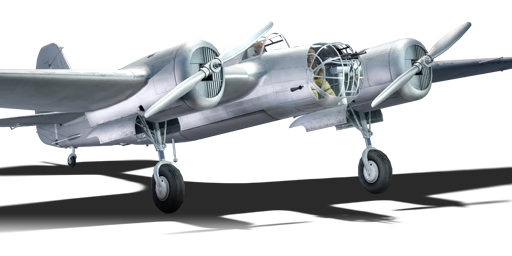



In 1933, the Soviet Air Force issued requirements for a high-speed, twin-engine bomber. In January 1934, the Tupolev Design Bureau began working on the new aircraft and built two prototypes: the ANT-40 RTs, which had Wright Cyclone engines, and the ANT-40 IS, which had Hispano-Suiza 12Y engines and an enlarged wing. The ANT-40 RTs made its first flight on October 7, 1934, and the ANT-40 IS took off on December 30. While the ANT-40 IS's flight characteristics impressed, it was plagued by various issues, resulting in a delayed start to serial production in late 1935. By that time, the Hispano-Suiza 12Y engines were being produced under license as the Klimov M-100. Thus, the aircraft itself was designated the SB 2M-100. However, it did not stay in production for long; it was soon replaced by the SB 2M-100A version, which had more powerful M-100A engines. Several hundred aircraft of this modification were produced in total.
The SB 2M-100A was introduced before the open beta test. It is a fast bomber with good defensive armament for fighting biplanes. However, it has almost no armor, a small bomb load compared to similar aircraft, and a terrible rate of climb.

flaps
flaps
flaps
brake
| Belt | Belt filling | Armor penetration (mm) at a distance: | |||||
|---|---|---|---|---|---|---|---|
| 10 m | 100 m | 500 m | 1000 m | 1500 m | 2000 m | ||
| T/Ball/Ball/AP-I/AI | 13 | 12 | 7 | 3 | 2 | 0 | |
| AP-I/AP-I/AP-I/API-T | 13 | 12 | 7 | 3 | 2 | 0 | |
| API-T/API-T/API-T/AI | 9 | 8 | 6 | 3 | 0 | 0 | |
| Belt | Belt filling | Armor penetration (mm) at a distance: | |||||
|---|---|---|---|---|---|---|---|
| 10 m | 100 m | 500 m | 1000 m | 1500 m | 2000 m | ||
| T/Ball/Ball/AP-I/AI | 13 | 12 | 7 | 3 | 2 | 0 | |
| AP-I/AP-I/AP-I/API-T | 13 | 12 | 7 | 3 | 2 | 0 | |
| API-T/API-T/API-T/AI | 9 | 8 | 6 | 3 | 0 | 0 | |


Flight performance | |
|---|---|
Survivability |
|---|
Weaponry | |
|---|---|