
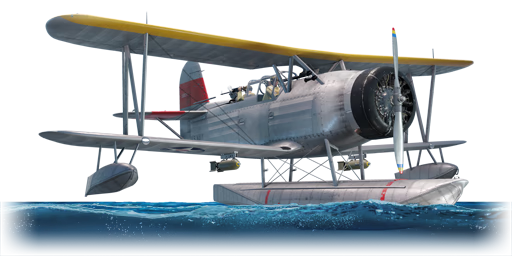

The SOC-1 was an American observation biplane, primarily designed and used during the interwar period and, to a lesser extent, in the Second World War. It was designed by Alexander Solla of the Curtiss-Wright Corporation. In 1933, the United States Navy ordered the SOC for production: the first order consisted of 135 SOC-1 biplanes, followed by 40 SOC-2 models and 83 SOC-3s. The SOC prototype completed its first flight in April 1934, and the aircraft entered service on 12 November 1935. The Naval Aircraft Factory also produced a variant of the SOC-3, designated SON-1. From 1935, Curtiss delivered these aircraft to the Navy until production ceased in 1938. The first ship to operate the SOC was the light cruiser USS Marblehead.
By 1941, most of the fleet had replaced the SOC with the OS2U Kingfisher. Cruisers were also expected to adopt the next-generation SO3C Seamew; however, the SO3C proved to be a failure. As a result, many retired SOC aircraft were returned to frontline service and continued to operate for several years after the war. Overall, the SOC series served as reliable shipboard observation planes during the conflict.
The SOC-1 was introduced in Update 2.13 “Winged Lions”. As a shipboard reconnaissance aircraft, it can be used for spotting torpedoes and monitoring enemy activity from the air. The aircraft is equipped with two 7.62 mm Browning machine guns, providing limited offensive and defensive capability. It also carries two 100 lb AN-M30A1 bombs, capable of inflicting damage on light targets.

flaps
flaps
flaps
brake
control
| Belt | Belt filling | Armor penetration (mm) at a distance: | |||||
|---|---|---|---|---|---|---|---|
| 10 m | 100 m | 500 m | 1000 m | 1500 m | 2000 m | ||
| T/Ball/Ball/Ball/AP/I | 13 | 12 | 7 | 3 | 2 | 0 | |
| T/AP/I | 13 | 12 | 7 | 3 | 2 | 0 | |
| AP/T/T/T/T | 13 | 12 | 7 | 3 | 2 | 0 | |
| AP/AP/AP/I/I | 13 | 12 | 7 | 3 | 2 | 0 | |
| Belt | Belt filling | Armor penetration (mm) at a distance: | |||||
|---|---|---|---|---|---|---|---|
| 10 m | 100 m | 500 m | 1000 m | 1500 m | 2000 m | ||
| T/Ball/Ball/AP/I | 13 | 12 | 7 | 3 | 2 | 0 | |
| T/AP/AP/AP/I | 13 | 12 | 7 | 3 | 2 | 0 | |