
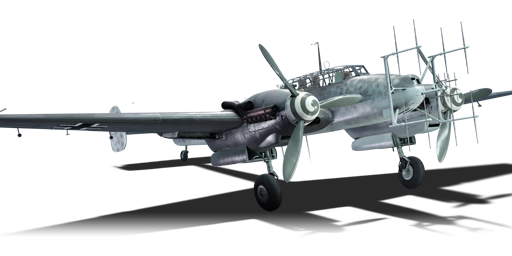



The Bf 110 G-4 was a German twin-engine night fighter used during World War II. The G series followed the F series and featured more powerful DB 605B engines and larger tail surfaces. The G-4 was designed specifically for night fighting and was equipped with the Liechtenstein FuG 220 radar. The aircraft also featured an unusual configuration consisting of a pair of upward-firing cannons known as Schräge Musik. This configuration proved to be a far more effective solution for destroying Allied bombers than conventional fighter attacks in certain situations. 679 Bf 110 G-4 were built, but with subvariants the number rises to 2208 planes. Production lasted from December 1942 up to April 1945.
The Bf 110 G-4 was introduced in Update 2.1 "New Power". Its primary roles are to intercept and destroy enemy ground-attack aircraft and bombers and to conduct ground attacks. Key features include high speed, good survivability, excellent armament (mounted and suspended), and an impressive bomb load for a strike aircraft. Unlike the Bf 110 G-2, the aircraft is equipped with radar to detect targets at high altitudes. However, because of the radar, the fighter can carry only two suspended cannons instead of four. The aircraft retains a general weakness of late Bf 110s: low maneuverability, which prevents it from competing in dogfights against the vast majority of single-engine fighters.

flaps
flaps
flaps
brake
| Belt | Belt filling | Armor penetration (mm) at a distance: | |||||
|---|---|---|---|---|---|---|---|
| 10 m | 100 m | 500 m | 1000 m | 1500 m | 2000 m | ||
| HEI-T/I | 6 | 6 | 6 | 6 | 6 | 6 | |
| HEI-T/HEI-T/HEI-T/HEF-I | 4 | 4 | 4 | 4 | 4 | 4 | |
| HEI-T/HEI-T/HEI-T | 4 | 4 | 4 | 4 | 4 | 4 | |
| HEI | 4 | 4 | 4 | 4 | 4 | 4 | |
| Belt | Belt filling | Armor penetration (mm) at a distance: | |||||
|---|---|---|---|---|---|---|---|
| 10 m | 100 m | 500 m | 1000 m | 1500 m | 2000 m | ||
| IT/IT/APHE/HEI | 21 | 19 | 8 | 3 | 1 | 1 | |
| IT/HEI/HEI/AP-I | 27 | 24 | 14 | 7 | 3 | 2 | |
| AP-I/HEI/HEI/HEI/HEI/IT | 27 | 24 | 14 | 7 | 3 | 2 | |
| APHE/APHE/APHE/IT | 21 | 19 | 8 | 3 | 1 | 1 | |
| FI-T/FI-T/FI-T/IT/IT | 21 | 19 | 8 | 3 | 1 | 1 | |
| HEI/HEI/HEI/APHE/AP-I | 27 | 24 | 14 | 7 | 3 | 2 | |
| Belt | Belt filling | Armor penetration (mm) at a distance: | |||||
|---|---|---|---|---|---|---|---|
| 10 m | 100 m | 500 m | 1000 m | 1500 m | 2000 m | ||
| IT/HEI/APHE | 19 | 18 | 15 | 10 | 4 | 4 | |
| Belt | Belt filling | Armor penetration (mm) at a distance: | |||||
|---|---|---|---|---|---|---|---|
| 10 m | 100 m | 500 m | 1000 m | 1500 m | 2000 m | ||
| AP-T/Ball/Ball/AP-I/AI | 9 | 8 | 6 | 3 | 0 | 0 | |
| AP/AP/AP/AP-T | 13 | 12 | 7 | 3 | 2 | 0 | |
| AP-I/AP-T/AP-I/AP-T | 9 | 8 | 6 | 3 | 0 | 0 | |
| Name | Weight | Slot | ||||
|---|---|---|---|---|---|---|
| 2 × | 224 kg |  | | |||
| 2 × | 100 kg |  | | |||
| 4 × | 200 kg |  | | |||
| 250 kg |  | | ||||
| 500 kg |  | | ||||
| 1,000 kg |  | |||||
| 110 kg |  | | ||||
| 225 kg |  | | ||||
| 2 × | 244.1 kg |  | ||||


 Bf 110 G-4
Flight performance | |
|---|---|
Weaponry | |||
|---|---|---|---|