
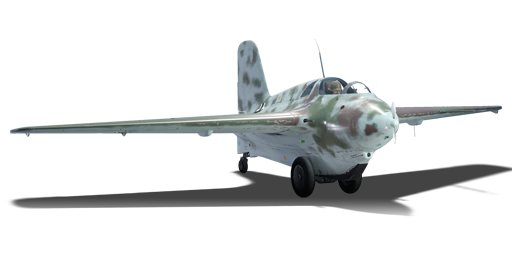



The Me 163 B-0 Komet was a rocket-powered German interceptor from World War II. It was a variant of the first production series, of which 47 aircraft were equipped with MG 151/20 cannons. Constant bombing of Germany by the Royal Air Force and, from 1942 onward, the U.S. Air Force forced the Third Reich's leadership to find ways to defend its airspace from increasingly powerful attacks. One of the proposed solutions was the Me 163, which was equipped with the latest rocket engine designed by Helmut Walter. Although the first prototype of the future Komet took flight as early as 1941, problems with the fuel line and the high toxicity of the fuel components led to frequent accidents, ranging from crew poisoning to aircraft explosions during takeoff. Development continued until 1944, and only 450 aircraft were built, which were assigned to three combat groups, only one of which was combat-ready. The Me 163 never became a "Wunderwaffe" it was supposed to be. According to various sources, the Komets shot down between nine and 16 enemy aircraft, losing about 11 of their own in combat. After the war, both the United States and the Soviet Union received design data and documentation for the aircraft. However, work on rocket-powered interceptor aircraft did not progress beyond test programs in either country.
The Me 163 B-0 was introduced in Update 1.81 "The Valkyries". This early variant of the Komet has 20mm cannons mounted in the fuselage and underwing pods, significantly improving its firepower. Like the main production variant, the early Me 163 boasts excellent acceleration and a high climb rate. However, its top speed is insufficient against potential opponents, so Komet pilots must rely on surprise attacks and force dogfights.

flaps
flaps
flaps
brake
| Belt | Belt filling | Armor penetration (mm) at a distance: | |||||
|---|---|---|---|---|---|---|---|
| 10 m | 100 m | 500 m | 1000 m | 1500 m | 2000 m | ||
| IT/IT/APHE/HEI | 21 | 19 | 8 | 3 | 1 | 1 | |
| IT/HEI/HEI/AP-I | 27 | 24 | 14 | 7 | 3 | 2 | |
| AP-I/HEI/HEI/HEI/HEI/IT | 27 | 24 | 14 | 7 | 3 | 2 | |
| APHE/APHE/APHE/IT | 21 | 19 | 8 | 3 | 1 | 1 | |
| FI-T/FI-T/FI-T/IT/IT | 21 | 19 | 8 | 3 | 1 | 1 | |
| HEI/HEI/HEI/APHE/AP-I | 27 | 24 | 14 | 7 | 3 | 2 | |


 Me 163 B-0
Flight performance |
|---|
Survivability |
|---|
Weaponry |
|---|