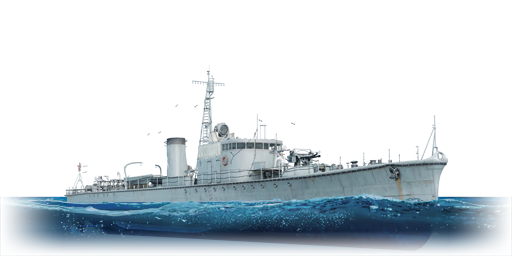



The Type K-7 No. 4 is a series of Japanese naval vessels built in the second half of the 1930s as part of the Third Fleet Construction Program. The Japanese solved the problems that plagued their predecessors, the K-3 class submarine chasers, when creating the K-7 class subchasers. In particular, they solved the insufficient hull strength. The K-7's equipment was largely similar to that of its predecessors, but it also featured innovations such as sonar, which enabled the detection of submarines beyond visual means. During World War II, ships of this series were used extensively in the Pacific Ocean.
The Type K-7 No. 4 was introduced in Update 1.89 "Imperial Navy". This subchaser has powerful and diverse artillery, as well as decent survivability. Its disadvantages include its large size and mediocre maneuverability.

| Belt | Belt filling | Armor penetration (mm) at a distance: | |||||
|---|---|---|---|---|---|---|---|
| 10 m | 100 m | 500 m | 1000 m | 1500 m | 2000 m | ||
| HEF/APHE/HEF/APHE | 36 | 35 | 30 | 25 | 22 | 20 | |
| HEF/HEF/HEF/APHE | 36 | 35 | 30 | 25 | 22 | 20 | |
| APHE/APHE/APHE/HEF | 36 | 35 | 30 | 25 | 22 | 20 | |
| HE-TF/HE-TF/HE-TF/HE-TF | 3 | 3 | 3 | 3 | 3 | 3 | |
| Belt | Belt filling | Armor penetration (mm) at a distance: | |||||
|---|---|---|---|---|---|---|---|
| 10 m | 100 m | 500 m | 1000 m | 1500 m | 2000 m | ||
| HEF-T/HEF/AP-T/HEI | 55 | 53 | 44 | 37 | 32 | 29 | |
| AP-T/AP-T/AP-T/HEF | 55 | 53 | 44 | 37 | 32 | 29 | |
| HEF-T/HEI/HEI/HEI | 5 | 5 | 4 | 4 | 4 | 4 | |
14 × Type 95 depth charge


Seakeeping |
|---|
Unsinkability | |
|---|---|
Firepower | ||
|---|---|---|