Type K-3 No.1



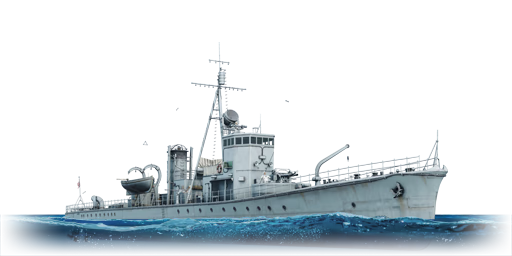
The Japanese Project K3, No.1-class Submarine Chaser No.1 was completed in March 1934 as a part of the Maru 1 Programme. It was the first class of the dedicated Anti-Submarine Warfare vessels in the Imperial Japanese Navy. The major advantage of the vessel was its high speed, while the key issue was a problem with the strength of the hull, which was later addressed in refits, modification of the No.3 subclass before it was built and finally, fully resolved in the No.4-class. She spent most of her service in the southern seas, survived the war without any notable successes, and finally was scuttled by the Royal Navy off Singapore.
The Type K-3 No.1 was introduced in Update 1.89 "Imperial Navy". The ship has a powerful and varied combination of weapons, as well as good survivability compared to the other vessels in her BR. Her main disadvantages come from being such a large vessel - she has a low manoeuvrability and is easy to hit with nearly anything, from bombs and rockets to artillery strikes.

| Belt | Belt filling | Armor penetration (mm) at a distance: | |||||
|---|---|---|---|---|---|---|---|
| 10 m | 100 m | 500 m | 1000 m | 1500 m | 2000 m | ||
| HEF/APHE/HEF/APHE | 36 | 35 | 30 | 25 | 22 | 20 | |
| HEF/HEF/HEF/APHE | 36 | 35 | 30 | 25 | 22 | 20 | |
| APHE/APHE/APHE/HEF | 36 | 35 | 30 | 25 | 22 | 20 | |
| HE-TF/HE-TF/HE-TF/HE-TF | 3 | 3 | 3 | 3 | 3 | 3 | |
| Belt | Belt filling | Armor penetration (mm) at a distance: | |||||
|---|---|---|---|---|---|---|---|
| 10 m | 100 m | 500 m | 1000 m | 1500 m | 2000 m | ||
| HEF-T/HEF/AP-T/HEI | 55 | 53 | 44 | 37 | 32 | 29 | |
| AP-T/AP-T/AP-T/HEF | 55 | 53 | 44 | 37 | 32 | 29 | |
| HEF-T/HEI/HEI/HEI | 5 | 5 | 4 | 4 | 4 | 4 | |


Seakeeping |
|---|
Unsinkability | |
|---|---|
Firepower | ||
|---|---|---|