
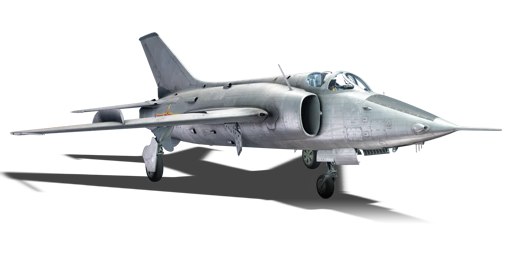
Q-5 early



The Q-5 early (强-5型强击机; NATO codename: Fantan), also known as the Eagle 302 project, was the first series of Q-5 attackers produced from 1969. It was developed after the PLAAF captured some coastal islands from the Nationalist forces and observed the effectiveness of the IL-10 attackers in air-land operations. However, the propeller-driven IL-10 was outdated by the late 1950s, when the PLAAF had acquired supersonic jets like the MiG-19 and its license-built version, the J-6. The PLAAF approved a design for a jet attacker based on the MiG-19, but with a side intake, called the Dongfeng 106. The design process was delayed by the economic difficulties during the Great Leap Forward and took ten years to complete. The final Q-5 model was accepted by the PLAAF in 1969 and remained in production until 1979, with 515 units built. The Q-5A variant replaced it in 1983.
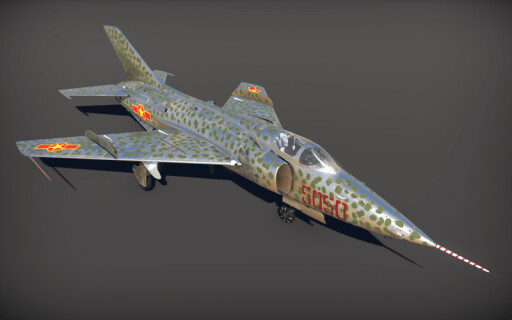
Introduced in Update "Raining Fire" as the first Chinese supersonic striker, the Q-5 early is the first jet aircraft of indigenous design in the Chinese tech tree. It is derived from the J-6/MiG-19, but it has a new forward fuselage with side-mounted air intakes and a pointed nose, giving it a sleek appearance. It is designed as an attacker, and it has better ground attack ordnance than the J-6A, including 90 mm rocket pods and up to four 250 kg bombs. It can also perform well in air-to-air combat, as it has similar flight characteristics and armament to the J-6A, but at a lower battle rating in Realistic Battles. The Q-5 is not very easy to fly, but skilled pilots can appreciate this iconic piece of Chinese aviation history.

flaps
flaps
flaps
brake
| Belt | Belt filling | Armor penetration (mm) at a distance: | |||||
|---|---|---|---|---|---|---|---|
| 10 m | 100 m | 500 m | 1000 m | 1500 m | 2000 m | ||
| AP-I/HEF-I | 31 | 29 | 20 | 13 | 8 | 5 | |
| HEF-I/AP-I/AP-I/AP-I | 31 | 29 | 20 | 13 | 8 | 5 | |
| HEF-I/HEF-I/HEF-I/AP-I | 31 | 29 | 20 | 13 | 8 | 5 | |
| AP-I | 31 | 29 | 20 | 13 | 8 | 5 | |
| Name | Weight | Slot | ||||
|---|---|---|---|---|---|---|
| 7 × | 153.5 kg |  | | |||
| 140 kg |  | | ||||
| 236 kg |  | | ||||
| 135 kg |  | | ||||
| 2 × | 280 kg |  | ||||
| 2 × | 472 kg |  | ||||
| 2 × | 270 kg |  | ||||


Flight performance | |
|---|---|
Survivability |
|---|
Weaponry | |
|---|---|