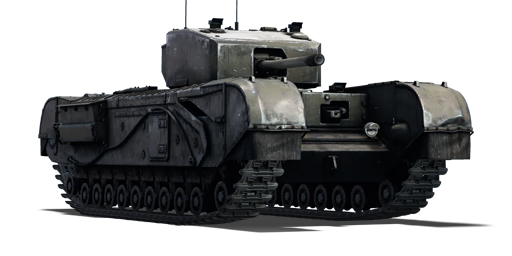
Churchill III


The Churchill III was an infantry tank developed and used by Britain during the Second World War. This variant featured significant improvements in armament over its predecessors, replacing the relatively weak 40 mm QF 2-pounder gun with the much more effective 57 mm QF 6-pounder gun. The hull howitzer present on the Churchill I was also removed and replaced with a machine gun. Compared to earlier turrets, this version featured a new design that was more boxy and squarish in shape. It also included several modifications to the transmission and engine. In total, 675 such vehicles were manufactured in 1942. This variant first saw combat during the Dieppe Raid, marking the Churchill tank’s first use in action. After that, it was mainly used in North Africa, including at the Second Battle of El Alamein. The Soviet Union received 301 Churchill tanks under the Lend-Lease programme, including Mk II, Mk III, and Mk IV variants. They saw limited service in the Soviet Army but participated in several major battles.
Introduced in Update 1.55 "Royal Armour", the Churchill III has relatively thick armour, especially at the front. Its separated crew layout also slightly increases its survivability. It is equipped with a decent gun capable of dealing with most opponents, and its fairly slow speed (a notable drawback of the Churchill) means it performs best in a heavy tank role when used efficiently but cautiously.

| Ammunition | Type | Armor penetration (mm) at a distance: | |||||
|---|---|---|---|---|---|---|---|
| 10 m | 100 m | 500 m | 1000 m | 1500 m | 2000 m | ||
| APC | 116 | 111 | 94 | 76 | 62 | 50 | |
| HE | 9 | 9 | 9 | 9 | 9 | 9 | |
| AP | 115 | 111 | 93 | 75 | 60 | 49 | |
| APCBC | 132 | 127 | 110 | 91 | 75 | 63 | |
| Belt | Belt filling | Armor penetration (mm) at a distance: | |||||
|---|---|---|---|---|---|---|---|
| 10 m | 100 m | 500 m | 1000 m | 1500 m | 2000 m | ||
| AP-I/AP-I/AP-T | 9 | 8 | 6 | 3 | 0 | 0 | |


Mobility | |
|---|---|
Protection |
|---|
Firepower | |
|---|---|