
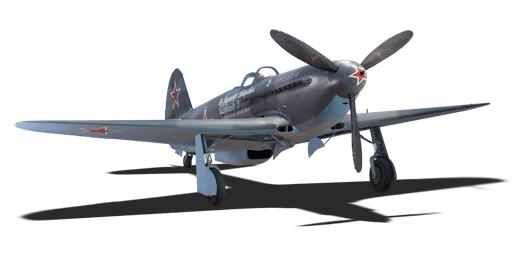
Eremin's Yak-3(e)


The Yakovlev Yak-3(r) is a Soviet single-engine fighter aircraft used during World War II. It was a further development of the Yak-1B, incorporating all of the Yakovlev Design Bureau's accumulated experience in weight and aerodynamics. During its development, a huge number of improvements were made, allowing for significant improvements in many flight characteristics without compromising firepower, pilot protection, or construction strength. The suffix (r) indicates that it belonged to the early production series with armament consisting of one 20 mm ShVAK cannon and one 12.7 mm UBS machine gun. A total of 197 aircraft were produced with this armament.
Testing of the Yak-3 began in 1943, and the first aircraft entered service with air regiments in June 1944. On May 29, 1944, collective farmer Ferapont Golovaty presented one of the new Yaks, belonging to the early series, to Boris Eremin. This was the second aircraft given to Eremin; in the winter of 1942, he was given a Yak-1B built with funds from Golovaty. Eremin scored eight aerial victories in his first aircraft. In his personalized Yak-3, he shot down six more enemy planes and celebrated Victory Day in Prague. After the war, the aircraft was transferred to the Central House of Aviation exhibition. After being restored in 1958, it was transferred to the Yakovlev Design Bureau Museum. In 1991, the aircraft ended up in the United States, where it was housed in the Flight Museum in Santa Monica, California. It returned to Russia in 2014 and is currently on display at the Vadim Zadorozhny Museum of Technology in the Moscow region.
The Eremin's Yak-3(e) was introduced as a reward for the 2024 "Legend of Victory" event. It is an exceptional fighter at altitudes up to 5,000 meters, but it has a limited ammunition capacity, subpar main armament, and a low maximum structural limit speed. While its good flight characteristics allow it to compete with other aircraft in its class, its mediocre survivability and vulnerable water-cooled engine leave it with little chance of survival once hit by the enemy.

flaps
flaps
flaps
brake
| Belt | Belt filling | Armor penetration (mm) at a distance: | |||||
|---|---|---|---|---|---|---|---|
| 10 m | 100 m | 500 m | 1000 m | 1500 m | 2000 m | ||
| FI-T/AP-I | 28 | 24 | 14 | 7 | 4 | 2 | |
| FI-T/HEF/AP-I/FI-T | 28 | 24 | 14 | 7 | 4 | 2 | |
| HEF/FI-T/AP-I | 28 | 24 | 14 | 7 | 4 | 2 | |
| FI-T | 4 | 4 | 4 | 4 | 4 | 4 | |
| AP-I/FI-T/AP-I/AP-I | 28 | 24 | 14 | 7 | 4 | 2 | |
| AP-I/HEF/HEF/FI | 28 | 24 | 14 | 7 | 4 | 2 | |
| Belt | Belt filling | Armor penetration (mm) at a distance: | |||||
|---|---|---|---|---|---|---|---|
| 10 m | 100 m | 500 m | 1000 m | 1500 m | 2000 m | ||
| T/AP/AP/IAI | 32 | 30 | 22 | 15 | 11 | 7 | |
| AP-I/API-T/IAI/IAI | 29 | 27 | 20 | 13 | 8 | 6 | |
| API-T/AP-I/AP-I/IAI | 29 | 27 | 20 | 13 | 8 | 6 | |
| AP-I(c)/AP-I/AP-I/API-T/IAI | 34 | 32 | 24 | 17 | 12 | 8 | |
| API-T | 29 | 27 | 20 | 13 | 8 | 6 | |
| AP-I/AP-I/IAI | 29 | 27 | 20 | 14 | 9 | 6 | |


 2 x (60 / 150 / 305) %
2 x 142 %
2 x (60 / 150 / 305) %
2 x 142 %
Flight performance | |
|---|---|
Survivability |
|---|
Weaponry |
|---|