
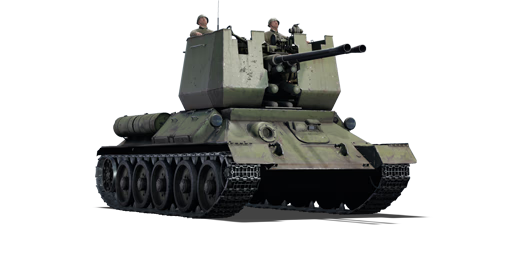
▂Phòng không T-34



The Xe tăng phòng không 37 mm (37 mm anti-air tank), known in short as the Phòng không T-34 (Chữ Nôm: 防空 T-34; English: Anti-air T-34), or mistakenly referred to as "Type 65" in some Chinese sources, was a North Vietnamese SPAAG developed during the mid-1960s for the Vietnam War. This vehicle utilises the hull of a T-34-85 with a unique open-top, box-style turret equipped with dual Chinese 37 mm Type 65 cannons. It is likely that the NVA improvised this design during the war, as North Vietnam heavily invested in anti-aircraft weaponry to counter US air support. However, no official NVA documentation on the vehicle has been found, and all known details come from a single unit captured by US forces, which is now on display at Fort Sill, Oklahoma. The name "Phòng không T-34" was created specifically for the game, following the naming conventions of other NVA vehicles from that era, as the vehicle’s actual designation is unknown.
The Phòng không T-34 was introduced as one of the rewards for the 2017 "Operation S.U.M.M.E.R." event for the Soviet tree. It is easily recognised by its box-shaped, open turret mounted on a T-34-85 hull, as well as the absence of the standard 85 mm main gun. It also has a higher profile than a typical T-34-85. While the turret’s armour offers minimal protection—sufficient only against rifle-calibre rounds—and nearby explosive blasts are likely to disable the vehicle instantly, the Phòng không T-34’s high turret traverse speed, adequate rate of fire, and HVAP shells enable it to perform effectively in both air defence and flanking roles.

| Belt | Belt filling | Armor penetration (mm) at a distance: | |||||
|---|---|---|---|---|---|---|---|
| 10 m | 100 m | 500 m | 1000 m | 1500 m | 2000 m | ||
| AP-T/HEFI-T | 70 | 68 | 56 | 45 | 36 | 29 | |
| HEFI-T | 8 | 8 | 7 | 5 | 4 | 3 | |
| AP-T | 70 | 68 | 56 | 45 | 36 | 29 | |
| HVAP-T | 87 | 82 | 65 | 49 | 37 | 28 | |


 2 x (120 / 150 / 220) %
2 x 166 %
2 x (120 / 150 / 220) %
2 x 166 %
Mobility | |
|---|---|
Protection |
|---|
Firepower | |
|---|---|