
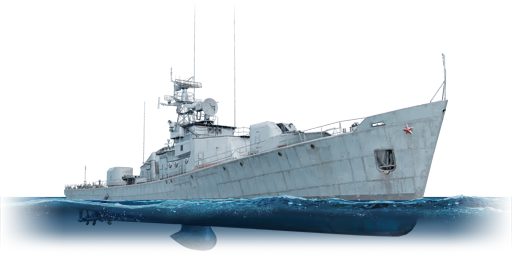
SKR-1



In the postwar years, the USSR sought to develop a new type of escort ship to replace the outdated Uragan-class guard ships and Project 29 vessels. The new ship had to be less expensive than a destroyer and capable of performing anti-submarine and convoy tasks. While the Project 42 and Project 50 escort ships generally met these requirements, they were quite large. Additionally, their armament and anti-submarine equipment were underwhelming. Consequently, in 1955, the Soviet navy gave specifications for a new ship and transferred them to the Zelenodolsk Design Bureau, where the ship was designated Project 159. The design of the escort ship was completed in 1956. Project 159 ships were built at Plants No. 820 in Kaliningrad, No. 340 in Zelenodolsk, and No. 368 in Khabarovsk. A total of 48 patrol ships of this type were built, some of which remain in service today.
The lead ship of the series was the SKR-1. It was laid down at plant No. 340 on August 31, 1957; launched on August 31, 1959; and entered service on December 30, 1961. Afterwards, it was attached to the Black Sea Fleet. From February 25 to July 29, 1974, the SKR-1 underwent repairs at the Sergo Ordzhonikidze Sevmorzavod shipyard. Between late 1977 and 1979, the ship again underwent modernization there, during which it was converted into an experimental vessel. On February 1, 1987, the ship was withdrawn from the Soviet Navy and later scrapped for metal in Sevastopol.
The SKR-1 was introduced in Update 1.79 "Project-X". While it boasts rapid-fire, versatile main guns in battle, its survivability is lacking and torpedoes are weak.
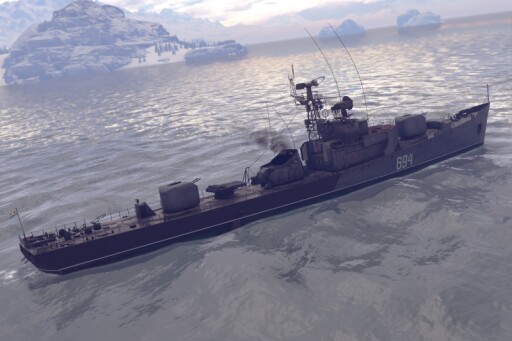

| Ammunition | Type | Armor penetration (mm) at a distance: | |||||
|---|---|---|---|---|---|---|---|
| 100 m | 1000 m | 2000 m | 3000 m | 4000 m | 5000 m | ||
| HE | 15 | 12 | 10 | 10 | 10 | 10 | |
| HE-VT | 16 | 13 | 11 | 11 | 11 | 11 | |
192 × RBU-2500 mortar


 SKR-1
SKR-1
Seakeeping |
|---|
Unsinkability | |
|---|---|
Firepower | ||
|---|---|---|