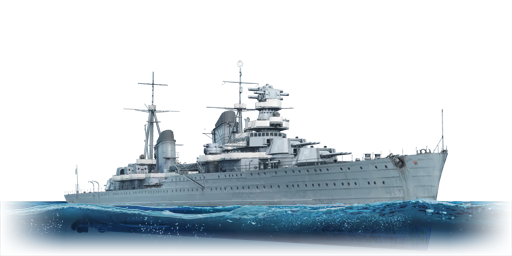
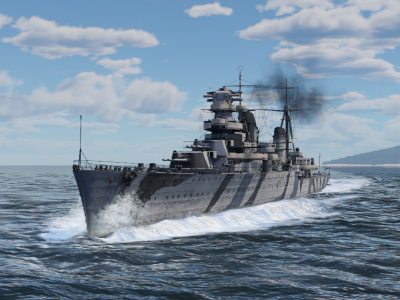
In the 1930s, the Maxim Gorky and its sister ship, the Kirov, became two of the first modern Soviet light cruisers. Although they were laid down only a year apart, Project 26 was continuously refined and improved in parallel. This led to the decision to complete the first two hulls ("Kirov" and "Voroshilov") according to the original design. Meanwhile, the remaining four hulls ("Maxim Gorky," "Molotov," "Kalinin," and "Kaganovich") were built according to the improved Project 26-bis.
The Maxim Gorky was laid down on December 20, 1936, at Shipyard No. 189 in Leningrad (hull No. 270), launched on April 30, 1938, and commissioned into the fleet on December 12, 1940. It actively operated in the Baltic Sea during the Winter War and the Great Patriotic War, repelling air raids, covering mine-laying operations, and providing artillery support to ground forces. In 1944, the ship was awarded the Order of the Red Banner of Battle. As it no longer met the requirements for first-line warships, it was assigned to the Kronstadt Naval Fortress detachment in 1953. In February 1956, the ship was withdrawn from active service in the Baltic Fleet and reclassified as an experimental cruiser. On April 18, 1959, it was removed from the Navy list and sent to be scrapped.
The Maxim Gorky was introduced as a reward for the 2020 Operation S.U.M.M.E.R. event. It is represented in its 1941 configuration. The cruiser has a fairly good main battery and excellent mobility but suffers from insufficient anti-aircraft armament and mediocre survivability due to the vulnerability of its main battery magazines.