
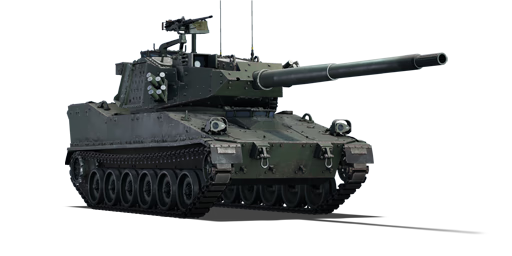
XM8

The U.S. Army actively used the M551 Sheridan during the Vietnam War, but its combat use revealed multiple shortcomings, such as poor survivability and slow reloading of the 152-mm gun. By 1978, most Sheridans had been retired in favor of the M3 Bradley, which was not a full replacement, however. Unsatisfied with this situation, the U.S. Army initiated the Armored Gun System (AGS) program in 1981 to develop a new light tank. As part of the program, in 1983, FMC began work on a vehicle designated the Close Combat Vehicle Light (CCVL). The tank was equipped with a 105mm M68A1 gun with an autoloader, armor protection against small arms, optional add-on armor kits, and modern electronics. To reduce costs and simplify maintenance, many components were taken from the M113 APC and the Bradley IFV. The first prototype was completed in August 1985, and testing and comparative trials with competitors, including the TCM AGS from Teledyne, as well as vehicles from Cadillac Gage and Hägglund, began in 1987. However, due to budget cuts that same year, the AGS program was canceled.
FMC continued working on its tank, introducing minor improvements and simplifying the design. In 1992, the U.S. Army ordered six prototypes under the designation XM8 AGS, the first of which was completed by 1994. Unfortunately, due to funding cuts and the retirement of program supporters, the planned number of production vehicles was reduced from 300 to 233 in 1993. The program was fully canceled in 1996. The company refused to abandon the project and participated in the Mobile Protected Firepower program in the 2010s, ultimately losing to the GDLS M10 Booker.
The XM8 was introduced as one of the rewards for the 2021 "Future Technology" event. Thanks to the 5-second autoloader, its classic 105-mm gun is even more effective than those of some main battle tanks. Laser rangefinder with a thermal sight for the gunner allow for accurate long-range fire. Additionally, its high mobility and top speed enable the XM8 to swiftly seize advantageous positions. However, its survivability is limited. The armor only protects against heavy machine gun fire. The small crew, most of whom are located in the turret, means a single hit could easily destroy the tank. Still, add-on armor kits can be installed to increase protection against automatic cannons, though this results in significant weight gain and loss of smoke launchers.

| Ammunition | Type | Armor penetration (mm) at a distance: | |||||
|---|---|---|---|---|---|---|---|
| 10 m | 100 m | 500 m | 1000 m | 1500 m | 2000 m | ||
| HEATFS | 400 | 400 | 400 | 400 | 400 | 400 | |
| HESH | 127 | 127 | 127 | 127 | 127 | 127 | |
| Smoke | 3 | 3 | 3 | 3 | 3 | 3 | |
| APFSDS | 292 | 291 | 284 | 275 | 266 | 257 | |
| APFSDS | 372 | 371 | 366 | 359 | 352 | 345 | |
| Belt | Belt filling | Armor penetration (mm) at a distance: | |||||
|---|---|---|---|---|---|---|---|
| 10 m | 100 m | 500 m | 1000 m | 1500 m | 2000 m | ||
| API-T/I/AP/API-T | 31 | 29 | 21 | 14 | 9 | 6 | |
| Belt | Belt filling | Armor penetration (mm) at a distance: | |||||
|---|---|---|---|---|---|---|---|
| 10 m | 100 m | 500 m | 1000 m | 1500 m | 2000 m | ||
| AP/T | 13 | 12 | 7 | 3 | 2 | 0 | |



Mobility | |
|---|---|
Protection |
|---|
Firepower | |||
|---|---|---|---|