
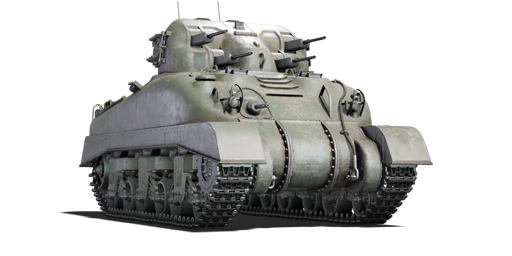
▃Skink




The Skink was an experimental Canadian self-propelled anti-aircraft gun developed in 1943–44. It was based on the M4 Sherman chassis. Three prototypes were built, and only one saw combat as part of the 2nd Canadian Armored Brigade. From February 6 to March 11, 1945, this single unusual vehicle was used by virtually all Canadian armored units on the Western Front against German troops. However, it never had the opportunity to open fire on enemy aircraft. Instead, the anti-aircraft gun unexpectedly proved to be a powerful psychological weapon against enemy infantry. There is one known instance in which a short burst from its four 20mm guns forced a company of 45 German soldiers to surrender. After completing its "combat tour," the vehicle was sent back to Canada, where it was later scrapped.
The Skink was introduced Update 2.41 "Firebirds" as a part of the American ground research tree. The Skink has several advantages over other nations' self-propelled guns. Its fully enclosed turret and hull, made from an M4A1 Sherman tank, make it invulnerable to cannon fire from various fighters and attack aircraft. The turret also protects against shrapnel from nearby bombs and rockets. Four 20 mm Polsten cannons allow the Skink to combat both enemy aircraft and lightly armored vehicles effectively. The Skink's only major drawback is its relatively small ammunition capacity of only 30 shells per barrel.

| Belt | Belt filling | Armor penetration (mm) at a distance: | |||||
|---|---|---|---|---|---|---|---|
| 10 m | 100 m | 500 m | 1000 m | 1500 m | 2000 m | ||
| AP-T/HEF-I/AP-T | 38 | 35 | 23 | 14 | 9 | 5 | |
| HEFI-T/HEF-I/HEF-I | 4 | 4 | 4 | 4 | 4 | 4 | |
| AP-T | 38 | 35 | 23 | 14 | 9 | 5 | |
| Belt | Belt filling | Armor penetration (mm) at a distance: | |||||
|---|---|---|---|---|---|---|---|
| 10 m | 100 m | 500 m | 1000 m | 1500 m | 2000 m | ||
| AP/T | 13 | 12 | 7 | 3 | 2 | 0 | |


Mobility | |
|---|---|
Protection |
|---|
Firepower | |
|---|---|