
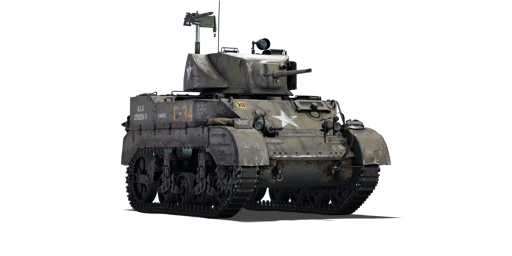
M5A1 TD

The M5 Stuart was an American light tank. As World War II intensified, the demand for radial engines grew rapidly because they were needed by the Air Force and ground forces to power tanks such as the M2A4 and M3 Stuart. Anticipating U.S. entry into the war, the Army requested in June 1941 that a "Stuart" be developed with standard Cadillac V8 automotive engines, which were widely available on the civilian market. This soon led to the creation of the M3E2 prototype, which received new engines and a new transmission. Meanwhile, testing had begun on the M3A1E1, which featured sloped hull armor and would later become known as the M3A3. A decision was soon made to combine these two designs into a single tank. As early as April 1942, production began under the designation M5 Stuart. A total of 2,074 of these vehicles were built by December of that year.
A more advanced version, the M5A1 Stuart, soon replaced it on the production line. The tank was fitted with a new turret featuring a more powerful radio, a new anti-aircraft machine gun mount, and a turret basket. Minor changes were also made to the tank’s hull. Despite criticism, the 37 mm M6 gun and the .30 cal anti-aircraft machine gun were retained. Additionally, the vehicle had significant engine reliability issues. Mass production of the M5A1 began in November 1942 and continued until June 1944. A total of 6,810 tanks of this variant were built.
The M5A1 TD was introduced as a reward for watching War Thunder streams on Twitch in 2021. Its unique camouflage corresponds to that of the C-34 “Carol” tank, which served in the 3rd Battalion of the 33rd Tank Regiment of the 3rd Armored Division and is now on display at the Normandy Tank Museum near Carentan, France. In combat, the M5A1 TD is a nimble vehicle with a gun that has good stabilization, allowing it to fire on the move, even at medium ranges. However, as a light tank, it has weak armor that only protects against autocannons. The crew is cramped, and the 37mm gun is insufficient for reliably penetrating enemy armor.

| Ammunition | Type | Armor penetration (mm) at a distance: | |||||
|---|---|---|---|---|---|---|---|
| 10 m | 100 m | 500 m | 1000 m | 1500 m | 2000 m | ||
| AP | 79 | 76 | 65 | 54 | 45 | 37 | |
| SAPHEI | 32 | 31 | 26 | 21 | 16 | 13 | |
| APCBC | 87 | 84 | 73 | 60 | 50 | 41 | |
| Belt | Belt filling | Armor penetration (mm) at a distance: | |||||
|---|---|---|---|---|---|---|---|
| 10 m | 100 m | 500 m | 1000 m | 1500 m | 2000 m | ||
| AP/T | 13 | 12 | 7 | 3 | 2 | 0 | |
| Belt | Belt filling | Armor penetration (mm) at a distance: | |||||
|---|---|---|---|---|---|---|---|
| 10 m | 100 m | 500 m | 1000 m | 1500 m | 2000 m | ||
| AP/T | 13 | 12 | 7 | 3 | 2 | 0 | |



Mobility | |
|---|---|
Protection |
|---|
Firepower | |
|---|---|