The USS North Carolina (BB-55) was the lead ship of the US Navy's North Carolina class of battleships. She was laid down on October 27, 1937; launched on June 13, 1940; and commissioned on April 9, 1941. The design of the battleships in this class began in the early 1930s. They were planned to have combat characteristics equal to the upper limits of the 1922 Washington Naval Treaty, but these parameters were adjusted to comply with the 1936 Second London Naval Treaty. After the Senate had approved the designs, it was discovered that Japan had refused to sign the 1936 treaty. This led to the ships' redesign to carry more powerful armaments. These ships are essentially the first "fast battleships" in the US Navy.
After being commissioned, the battleship spent some time in the Caribbean. However, after the attack on Pearl Harbor, she began intensive combat training. In April 1942, the North Carolina departed for Newfoundland, where she joined a force tasked with hunting the German battleship Tirpitz should she enter the Atlantic. However, by early June, the battleship had already passed through the Panama Canal and departed for the Pacific. There, she actively participated in the Guadalcanal Campaign and proved herself to be a highly effective ship. North Carolina was part of Task Force 16, providing cover for carrier groups and bombarding coastal fortifications. The battleship subsequently participated in operations in the Gilbert and Marshall Islands, the Marianas campaign, and the Palau Islands campaign. North Carolina also participated in the Philippines campaign, capturing Iwo Jima and Okinawa.
Like many other ships, she participated in the operation to repatriate American troops after the war. She earned 15 battle stars during the war, a record for any American battleship. After returning to the United States for repairs, she took part in exercises and training in the Caribbean. On June 27, 1947, she was decommissioned. Various modernization plans for the battleship were considered until 1960, but none were approved. Finally, in 1960, she was stricken from the list. In 1962, she was towed to Wilmington, where she remains a memorial to this day. In 2024, she was recognized as one of the most visited sites in North Carolina.
The USS North Carolina was introduced in Update 2.57 "Heavy Cavalry" in her 1942 modification. The North Carolina boasts a powerful main battery, a rapid-fire and versatile secondary battery, a decent complement of small-caliber anti-aircraft artillery, and good protection. Her weaknesses include her speed and the explosiveness of her ready-use ammo for her secondary batteries.
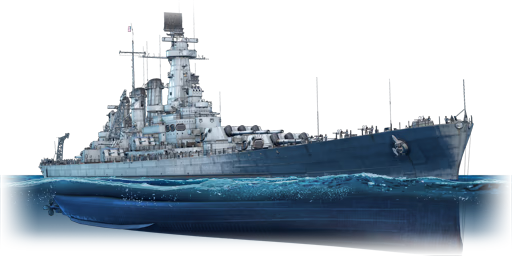


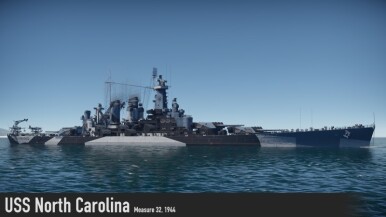



 USS North Carolina