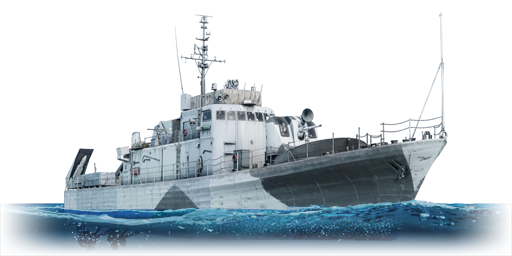
The USS Douglas (PG-100) was one of 17 Asheville-class patrol gunboats built for the US Navy in the late 1960s. She was built by Tacoma Boatbuilding Co. in Washington, launched on 19 June 1970, and commissioned on 6 February 1971. Compared to the earlier sister ships, Douglas was to be outfitted with surface-to-air missiles (SAM), in this case a pair of RIM-24 Tartar missile launchers at the stern to deal with air targets. During her relatively short six-year military career, Douglas was stationed in Naples, Italy and participated in various NATO exercises and operations. On 1 October 1977, Douglas was decommissioned and transferred to the Naval Sea Systems Command (NAVSEA) to be used as a research ship. Renamed R/V Lauren, the ship would serve around Panama City, Florida until she was decommissioned in 2008. Lauren was then sunk on 30 April 2008 on a sandbank off the coast of North Carolina as a target for USMC fighter pilots stationed there.
The USS Douglas was introduced in Update "Danger Zone". Although belonging to the Asheville-class, the Douglas is drastically different from her sister ship due to the replacement of her rear turret with a pair of RIM-24A Tartar SAM launchers. This considerably advanced armament features a SACLOS guidance system, allowing the captain to easily take aim at any approaching aircraft with mouse control and shoot them down. Due to the aforementioned guidance system, the range of up to 14 km, and the large warhead size, the Tartar can also be used as an ad-hoc anti-ship missile (AShM) in a pinch against surface vessels. With good aim, it can even sink a destroyer or cruiser in one hit via magazine detonation. However, the Douglas carries only four RIM-24A in total, and after they are spent she is left with a mediocre 76 mm gun, therefore leaving her vulnerable up close.