
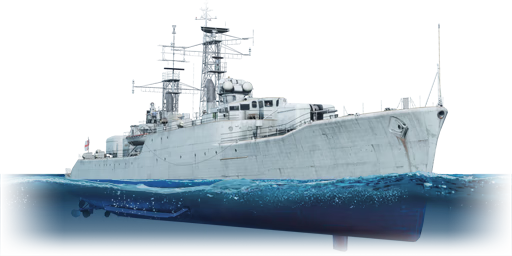
HMS Leopard



The HMS Leopard (F14) was a British air defense frigate and the lead ship of the Leopard class. She was laid down at the Portsmouth Dockyard on March 25, 1953; launched on May 23, 1955; and commissioned on September 30, 1958. Since the Leopard was intended for air defense of transport ships, most of her arsenal consisted of Mark V 114 mm universal guns. In 1961, the Leopard arrived in Tristan da Cunha, where her crew assisted local residents affected by the eruption of Queen Mary's Peak volcano. In 1963, the frigate was seriously damaged in a collision with the South African minesweeper Pietermaritzburg during exercises off Cape Point. Subsequently, the Leopard was sent to the Simonstown naval base for partial repairs and later transferred to Portsmouth for complete repairs. The ship remained in service with the Royal Navy until December 1975. After that, she was decommissioned and scrapped in 1977.
The HMS Leopard was introduced in Update 2.7 "Red Skies". The frigate has powerful and versatile artillery, as well as good survivability, thanks to her 205 crew members. Her disadvantages include low speed and a complete lack of torpedo armament.

| Ammunition | Type | Armor penetration (mm) at a distance: | |||||
|---|---|---|---|---|---|---|---|
| 1000 m | 2500 m | 5000 m | 7500 m | 10000 m | 15000 m | ||
| HE | 28 | 28 | 28 | 28 | 28 | 28 | |
| SAP | 142 | 119 | 89 | 67 | 52 | 42 | |
| HE-TF | 28 | 28 | 28 | 28 | 28 | 28 | |
| HE-VT | 28 | 28 | 28 | 28 | 28 | 28 | |
| Belt | Belt filling | Armor penetration (mm) at a distance: | |||||
|---|---|---|---|---|---|---|---|
| 10 m | 100 m | 500 m | 1000 m | 1500 m | 2000 m | ||
| AP-T/HEFI-T | 81 | 78 | 69 | 61 | 55 | 50 | |
| AP-T/AP-T/AP-T/HEFI-T | 81 | 78 | 69 | 61 | 55 | 50 | |
| HEFI-T/HEFI-T/HEFI-T/AP-T | 81 | 78 | 69 | 61 | 55 | 50 | |


 HMS Leopard
Seakeeping |
|---|
Unsinkability | |
|---|---|
Firepower | ||
|---|---|---|