
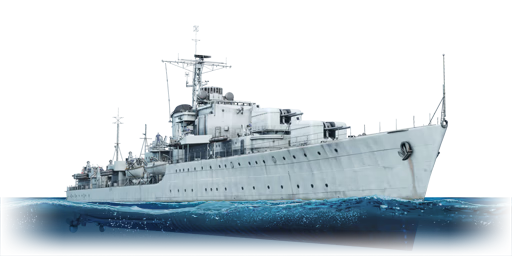




The HMAS Tobruk (D37) belongs to the Battle-class destroyer family, which was developed during the war based on the Royal Navy's experience of numerous naval battles. All of the destroyers in this series were named after naval and coastal battles fought by the British Empire, hence the class's collective name, 'Battle'. Tobruk was named after the first defence of Tobruk in 1941. Ironically, none of them, except the lead ship Barfleur, saw action in the war. Barfleur itself only played a minor role, appearing at the very end in the Far East to accept Japan's surrender.
The Tobruk was laid down at Cockatoo Docks and Engineering Company. Pty. Ltd.'s shipyard in Sydney on 5 August 1946. It was launched on 20 December 1947 and commissioned on 8 May 1950. In August 1951, she arrived in Japan. From October onwards, it took part in the Korean War. On 22 February 1952, it returned to Australia. Between September and October 1952, it accompanied the aircraft carrier Sydney on a voyage to the Manus Islands, participating in the support of testing the first British nuclear bomb. On 26 June 1953, it arrived off the coast of Korea again, where it participated in patrolling coastal waters until January 1954. From September to November 1956, it operated off the coast of Malaysia, shelling areas of guerrilla activity in the state of Johor. Between 1959 and 1960, it underwent repairs. Afterwards, it visited a number of ports in New Caledonia and New Guinea with the destroyer Anzac. In September 1960, it was damaged by a shell accidentally fired from the Anzac during exercises. Following emergency repairs in Jervis Bay, it arrived in Sydney, where it was decommissioned on 29 October 1960. It was sold for scrap on 15 February 1972.
The HMAS Tobruk was introduced in Update 1.95 "Northern Wind". Unlike most British destroyers, the Tobruk stands out with its powerful anti-aircraft artillery, while retaining the ability to conduct effective artillery and torpedo attacks on enemy ships. Still, it will not outgun some of the more powerful american destroyers, and its torpedoes are much weaker than japanese ones.

| Ammunition | Type | Armor penetration (mm) at a distance: | |||||
|---|---|---|---|---|---|---|---|
| 1000 m | 2500 m | 5000 m | 7500 m | 10000 m | 15000 m | ||
| HE | 28 | 28 | 28 | 28 | 28 | 28 | |
| SAP | 142 | 119 | 89 | 67 | 52 | 42 | |
| HE-TF | 28 | 28 | 28 | 28 | 28 | 28 | |
| HE-VT | 28 | 28 | 28 | 28 | 28 | 28 | |
| Belt | Belt filling | Armor penetration (mm) at a distance: | |||||
|---|---|---|---|---|---|---|---|
| 10 m | 100 m | 500 m | 1000 m | 1500 m | 2000 m | ||
| AP-T/HEFI-T | 81 | 78 | 69 | 61 | 55 | 50 | |
| AP-T/AP-T/AP-T/HEFI-T | 81 | 78 | 69 | 61 | 55 | 50 | |
| HEFI-T/HEFI-T/HEFI-T/AP-T | 81 | 78 | 69 | 61 | 55 | 50 | |
| Belt | Belt filling | Armor penetration (mm) at a distance: | |||||
|---|---|---|---|---|---|---|---|
| 10 m | 100 m | 500 m | 1000 m | 1500 m | 2000 m | ||
| AP-T/HEFI-T | 81 | 78 | 69 | 61 | 55 | 50 | |
| AP-T/AP-T/AP-T/HEFI-T | 81 | 78 | 69 | 61 | 55 | 50 | |
| HEFI-T/HEFI-T/HEFI-T/AP-T | 81 | 78 | 69 | 61 | 55 | 50 | |


 HMAS Tobruk
Seakeeping |
|---|
Unsinkability | |
|---|---|
Firepower | ||
|---|---|---|