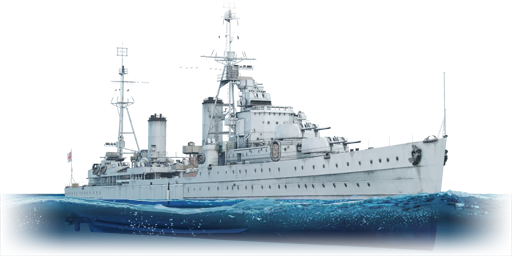
HMS Arethusa (26) was the lead ship in a series of British light cruisers of the same name. She was laid down on January 25, 1933; launched on March 6, 1934; and commissioned on May 23, 1935. The cruiser played an active role in combat operations during World War II. Initially assigned to the Home Fleet, the ship participated in the Norwegian campaign. Subsequently, as part of the N Group, the cruiser served in the Mediterranean Sea. The ship took part in the attack on Mers-el-Kébir but was later temporarily returned to the Metropolitan Fleet due to the threat of German battleships. Afterward, she returned to the Mediterranean Sea. She escorted convoys to Malta for a long time and participated in the raid on the Lofoten Islands (Operation Anklet). She also took part in Operations Stone Age and Overlord, during which she transported King George VI to the shores of Normandy. In October 1945, the cruiser returned to Great Britain and was placed in reserve. In 1946, there were discussions about modernizing or selling the cruiser to the Royal Norwegian Navy, but neither plan was implemented. In 1949, the ship was used as a floating laboratory for naval experiments. In 1950, she was sold for scrap.
HMS Arethusa was introduced in Update 1.91 “Night Vision” in her 1943 modification. The cruiser has a decent anti-aircraft battery and good secondary caliber guns, but suffers from a lack of main caliber firepower and low survivability.