
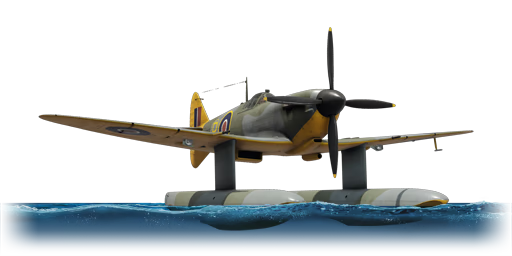
Spitfire Mk Vb (Float)


During the 1940 Norwegian campaign, the British aviation force was short on airfields. One solution proposed was to equip the production-ready Spitfire and Hurricane fighters with floats so they could operate from water. The conversion of a Spitfire Mk.I into a floatplane, completed in April 1940, was good on scale model tests and confirmed that it was easy to do. However, after the campaign ended and the immediate need disappeared, the aircraft was returned to its standard configuration, the project was suspended, and Spitfire Mk.I never flew with floats.
The idea was revived in 1942 as fighting expanded in the Mediterranean. This time, three prototypes were built based on the Spitfire Mk Vb. They were fitted with specially designed floats, an enlarged vertical tail, an additional ventral fin, and a four-bladed propeller. The first flight of this version took place on October 12, 1942. In 1943, the aircraft were sent to Egypt, where they were based at the Great Bitter Lake and used for trials under near-combat conditions. Plans were made to create a hidden base for these aircraft in the Mediterranean, but the intended islands were captured by the Germans. The concept saw limited further development in the form of the float-equipped Spitfire Mk. IX in 1944, but it was soon abandoned altogether.
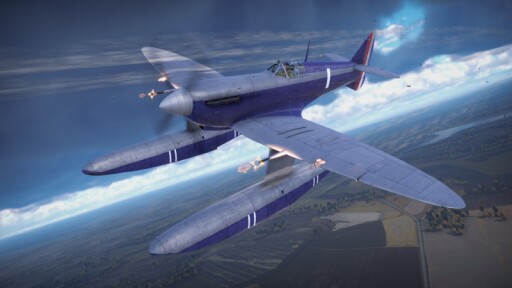
The Spitfire Mk Vb (Float) was introduced as a reward for participating in the 2026 "Wings Over Water" event. This unusual fighter combines good flight performance and excellent maneuverability with the ability to take off from and land on water. While it can effectively compete against most opponents at its rank, the added floats reduce its overall performance compared to the standard Spitfire Mk. Vb. Additionally, it is difficult to use conventional airfields for takeoff and landing.

flaps
flaps
flaps
brake
control
| Belt | Belt filling | Armor penetration (mm) at a distance: | |||||
|---|---|---|---|---|---|---|---|
| 10 m | 100 m | 500 m | 1000 m | 1500 m | 2000 m | ||
| HEI/SAP-I/T | 22 | 20 | 14 | 9 | 6 | 4 | |
| AP-T/HEI/SAP-I | 37 | 35 | 25 | 16 | 10 | 7 | |
| AP-T/HEI/SAP-I/HEI/SAP-I | 37 | 35 | 25 | 16 | 10 | 7 | |
| AP-T/HEI/AP-T | 37 | 35 | 25 | 16 | 10 | 7 | |
| AP-T/SAP-I/HEI/AP-T | 37 | 35 | 25 | 16 | 10 | 7 | |
| HEI/HEI/SAP-I | 22 | 20 | 14 | 9 | 6 | 4 | |
| Belt | Belt filling | Armor penetration (mm) at a distance: | |||||
|---|---|---|---|---|---|---|---|
| 10 m | 100 m | 500 m | 1000 m | 1500 m | 2000 m | ||
| T/AP/AP-I/Ball/Ball/I | 13 | 12 | 7 | 3 | 2 | 0 | |
| T/AP/AP-I/AP-I/I | 13 | 12 | 7 | 3 | 2 | 0 | |
| IT/AP-I | 13 | 12 | 7 | 3 | 2 | 0 | |
| AP-I/AP-I/I | 13 | 12 | 7 | 3 | 2 | 0 | |


 2 x (40 / 95 / 195) %
2 x 124 %
2 x (40 / 95 / 195) %
2 x 124 %
Flight performance | |
|---|---|
Survivability |
|---|
Weaponry | |
|---|---|