
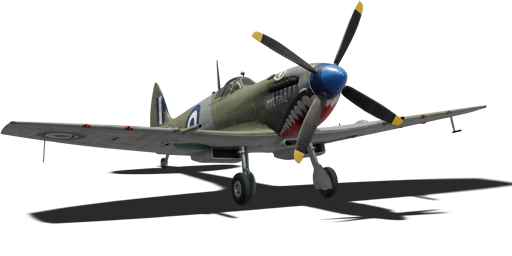
▄Spitfire LF Mk IXc (CW)



The Spitfire LF Mk IXc (CW) was one of the most widely produced models of the Spitfire, with over 4,000 aircraft built, while also being one of the last to be produced without the Griffon engine, being equipped with the iconic Merlin 66 engine instead. As the Merlin 66 engine offered great performance at low altitudes compared to the Merlin 61-equipped Spitfire F Mk IX counterparts, these Spitfires were designated LF (low-altitude fighter). Due to how the Spitfire was constructed, it was possible for the wings to be "clipped" in order to further boost low-altitude performance, and thus these aircraft gained the CW (clipped-wing) designation. Clipping the wings of the Spitfire reduced the aircraft's lift but significantly improved its roll rate and increased its top speed at low altitude.
In January 1947, as Greece was in a civil war, the Royal Hellenic Air Force received 121 Spitfire LF and HF Mk IX aircraft from the United Kingdom. These aircraft were used extensively in recon-by-force missions, utilising their rockets, as well as explosive and napalm bombs. The Spitfire LF Mk IXc (CW) "Μύστρας", with the tail number MH558, was flown by Lieutenant Georgios Smyrniotopoulos. The Spitfire LF Mk IX was retired from service a few years after the end of the war, in 1953.
Introduced as a reward for the Battle Pass: Season XXIII, "Apollo’s Chariot", the Greek Spitfire LF Mk IXc (CW) is almost identical to the Spitfire Mk.IX (CW) found in the tech tree, with minor differences in armament selection. Being a Mk IX with clipped wings, it offers great low-altitude performance and climb rate but cannot compete with dedicated high-altitude fighters.

flaps
flaps
flaps
brake
| Belt | Belt filling | Armor penetration (mm) at a distance: | |||||
|---|---|---|---|---|---|---|---|
| 10 m | 100 m | 500 m | 1000 m | 1500 m | 2000 m | ||
| HEI/SAP-I/T | 22 | 20 | 14 | 9 | 6 | 4 | |
| AP-T/HEI/SAP-I | 37 | 35 | 25 | 16 | 10 | 7 | |
| AP-T/HEI/SAP-I/HEI/SAP-I | 37 | 35 | 25 | 16 | 10 | 7 | |
| AP-T/HEI/AP-T | 37 | 35 | 25 | 16 | 10 | 7 | |
| AP-T/SAP-I/HEI/AP-T | 37 | 35 | 25 | 16 | 10 | 7 | |
| HEI/HEI/SAP-I | 22 | 20 | 14 | 9 | 6 | 4 | |
| Belt | Belt filling | Armor penetration (mm) at a distance: | |||||
|---|---|---|---|---|---|---|---|
| 10 m | 100 m | 500 m | 1000 m | 1500 m | 2000 m | ||
| T/AP/AP-I/Ball/Ball/I | 13 | 12 | 7 | 3 | 2 | 0 | |
| T/AP/AP-I/AP-I/I | 13 | 12 | 7 | 3 | 2 | 0 | |
| IT/AP-I | 13 | 12 | 7 | 3 | 2 | 0 | |
| AP-I/AP-I/I | 13 | 12 | 7 | 3 | 2 | 0 | |
| Name | Weight | Slot | ||||||
|---|---|---|---|---|---|---|---|---|
| 117.9 kg |  | | ||||||
| 109.8 kg | | | ||||||
| 117.9 kg | | |||||||
| 109.8 kg | | |||||||
| 242.6 kg |  | |||||||
| 226.3 kg | | |||||||
| 222.3 kg |  | |||||||


 2 x (100 / 225 / 475) %
2 x 172 %
2 x (100 / 225 / 475) %
2 x 172 %
Flight performance | |
|---|---|
Survivability |
|---|
Weaponry | ||
|---|---|---|