
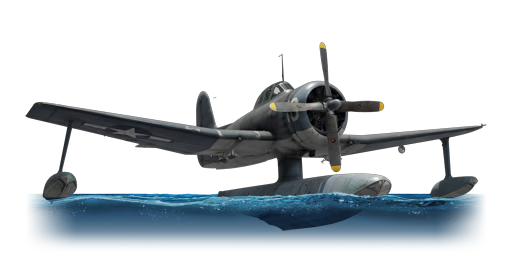
SC-1

The Curtiss SC-1 Seahawk was an American reconnaissance floatplane used in the later stages of World War II and after the war. The development of this aircraft began in 1942, when the US Navy Bureau of Aeronautics issued a request for observation seaplanes. It was intended to replace older aircraft such as the Vought OS2U Kingfisher and the Curtiss SOC-1 Seagull with a more capable design. Curtiss proposed the Seahawk in August 1942 and soon received an order for 500 aircraft, even before its first flight. The maiden flight of the XSC-1 prototype took place in February 1944. After minor modifications, serial production of the SC-1 began, with 577 floatplanes eventually delivered to the Navy. These aircraft were delivered with conventional landing gear, with floats being fitted by the Navy as needed, and was capable of operating with either, making it one of the more capable American floatplanes of World War II. In addition, a modified prototype with a revised cockpit layout was designated SC-2, but it was not developed further.
Although the aircraft did not see extensive combat during the war, it was used during the Borneo campaign in 1945. However, after the end of hostilities, it was gradually replaced by helicopters and was withdrawn from service in 1949. This shift occurred because helicopters were simpler to operate and did not require the specialised equipment needed for floatplanes.
Introduced in Update 2.47 "Leviathans", the SC-1 offers decent manoeuvrability but has relatively low speed. As for armament, it is equipped with two 250 lb bombs and two forward-firing 12.7 mm M2 Browning machine guns, giving it an effective weapons loadout.

flaps
flaps
flaps
brake
control
| Belt | Belt filling | Armor penetration (mm) at a distance: | |||||
|---|---|---|---|---|---|---|---|
| 10 m | 100 m | 500 m | 1000 m | 1500 m | 2000 m | ||
| T/Ball/I/AP | 30 | 27 | 20 | 13 | 9 | 6 | |
| AP/AP/AP/T/I | 30 | 27 | 20 | 13 | 9 | 6 | |
| T/AP/AP/AP | 30 | 27 | 20 | 13 | 9 | 6 | |
| T/T/T/AP | 30 | 27 | 20 | 13 | 9 | 6 | |
| AP/I/AP | 30 | 27 | 20 | 13 | 9 | 6 | |