
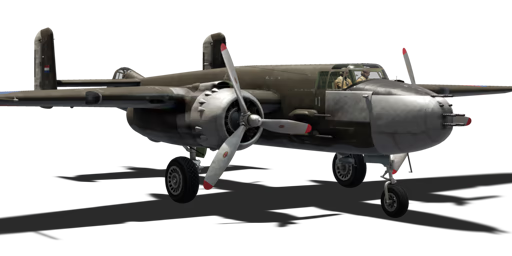
◘SB-25J



The B-25 Mitchell was an American twin-engine bomber that became the workhorse of many Allied bomber squadrons and air units. In 1941, the Dutch government in exile ordered 162 B-25C aircraft to counter Japanese aggression in the Dutch East Indies. The aircraft were delivered to the region by various means. Some flew directly from the United States, while others were transported by sea to India or Australia, from which they continued on their own. The Dutch ultimately received 150 bombers, including SB-25s with additional nose-mounted weapons. In 1944, the B-25J replaced them. Some of the aircraft were used by the Royal Air Force in the 320th Squadron under Dutch pilot control. The squadron was disbanded in August 1945.
After the war, the Netherlands retained most of its aircraft. However, they now had to fight colonial uprisings in a manner similar to the war with Japan. When the revolution in Indonesia began in 1946, the 18th Bomber Squadron, equipped with B-25s, was sent to the Dutch East Indies. Each aircraft was modified slightly differently, but most often, the upper turret was removed, and additional machine guns were installed in the nose. The squadron participated in the war until Indonesia became a state in 1949. Afterward, some of the aircraft were abandoned, while the rest were sent to Europe. The Indonesian Air Force subsequently used the abandoned B-25s, and the last Dutch Mitchell squadron was disbanded on July 26, 1950.
The Dutch SB-25J was introduced as a reward for Battle Pass: Season XX, "Flying Dragon" in the French aviation research tree. In many ways, it resembles the B-25J; its good payload, armament, and survivability make it quite versatile. The major difference is that the SB-25 received additional machine guns in the nose while losing its upper turret. However, its poor flight characteristics remained unchanged.

flaps
flaps
flaps
brake
| Belt | Belt filling | Armor penetration (mm) at a distance: | |||||
|---|---|---|---|---|---|---|---|
| 10 m | 100 m | 500 m | 1000 m | 1500 m | 2000 m | ||
| T/Ball/Ball/I/AP-I | 28 | 26 | 18 | 11 | 7 | 4 | |
| AP-I/AP-I/AP-I/T/I | 28 | 26 | 18 | 11 | 7 | 4 | |
| T/AP/AP/AP/AP-I/I | 30 | 27 | 20 | 13 | 9 | 6 | |
| T/T/T/T/T/AP-I | 28 | 26 | 18 | 11 | 7 | 4 | |
| AP/AP-I/AP-I/I/I | 30 | 27 | 20 | 13 | 9 | 6 | |
| Belt | Belt filling | Armor penetration (mm) at a distance: | |||||
|---|---|---|---|---|---|---|---|
| 10 m | 100 m | 500 m | 1000 m | 1500 m | 2000 m | ||
| T/AP/I/AP-I | 30 | 27 | 20 | 13 | 9 | 6 | |
| AP/AP/AP/T | 30 | 27 | 20 | 13 | 9 | 6 | |
| AP-I/AP-I/AP-I/T | 28 | 26 | 18 | 11 | 7 | 4 | |
| Belt | Belt filling | Armor penetration (mm) at a distance: | |||||
|---|---|---|---|---|---|---|---|
| 10 m | 100 m | 500 m | 1000 m | 1500 m | 2000 m | ||
| T/AP/I/AP-I | 30 | 27 | 20 | 13 | 9 | 6 | |
| AP/AP/AP/T | 30 | 27 | 20 | 13 | 9 | 6 | |
| AP-I/AP-I/AP-I/T | 28 | 26 | 18 | 11 | 7 | 4 | |
4 × 250 lb AN-M57 bomb
2 × 500 lb AN-M64A1 bomb
1000 lb AN-M65A1 bomb


 2 x (80 / 170 / 315) %
2 x 142 %
2 x (80 / 170 / 315) %
2 x 142 %
Flight performance | |
|---|---|
Survivability |
|---|
Weaponry | |
|---|---|