
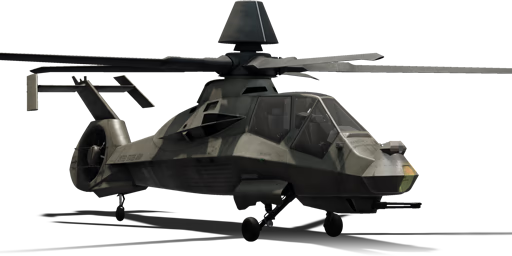
RAH-66


In the early 1980s, the U.S. Armed Forces launched the Light Helicopter Experimental program to develop a new reconnaissance helicopter that would replace the OH-6 and OH-58. Nearly a decade was spent refining the aircraft's requirements, primarily emphasizing low radar, acoustic, and thermal signatures. In October 1988, the competition for the new helicopter was officially announced with two teams participating: Sikorsky and Boeing versus Bell and McDonnell. Sikorsky and Boeing were declared the winners in April 1991. The first conceptual prototype was assembled in May 1995, and the aircraft made its maiden flight in January 1996. Due to thorough development, the aircraft produced positive results, and all major issues were resolved by December 2000.
In June 2000, the U.S. Armed Forces ordered the first five RAH-66 Comanche prototypes for state trials, planning to deliver them in 2004. However, prolonged development and increasing requirements caused the technologies used to become obsolete, as well as increasing the costs of both the production aircraft and the program as a whole. Due to budget cuts and a shift in focus toward counterterrorism operations, the program was canceled in February 2004. Two prototypes were built in total, and both are currently located at the U.S. Army Aviation Museum at Fort Rucker in Alabama.
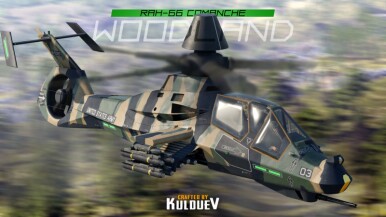
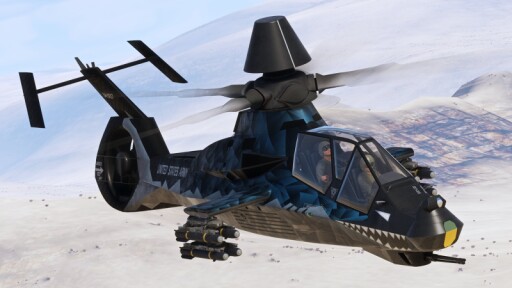
The RAH-66 was introduced in Update 2.47 "Leviathans". Its main feature is reduced radar and thermal visibility. The Comanche can fire anti-tank missiles while remaining nearly invisible to radar systems; infrared-guided missiles can only lock onto it from very short distances. It is equipped with a radar with a wide field of view to detect ground and air targets. However, it should be noted that the Comanche must maintain visual contact with the target to guide Hellfire missiles, leaving it vulnerable to faster surface-to-air missiles. Additionally, it lacks flares and chaff, so missile lock cannot be broken. Fortunately, its high maneuverability allows it to quickly take cover behind terrain. To defend against aircraft, the Comanche can carry a large number of Stinger missiles and a rapid-firing 20 mm cannon with wide aiming angles.

| Belt | Belt filling | Armor penetration (mm) at a distance: | |||||
|---|---|---|---|---|---|---|---|
| 10 m | 100 m | 500 m | 1000 m | 1500 m | 2000 m | ||
| HEF-I/API-T/AP-I/SAPHEI | 40 | 36 | 21 | 11 | 6 | 3 | |
| HEF-I/HEF-I/API-T/HEF-I/HEF-I/AP-I | 40 | 36 | 21 | 11 | 6 | 3 | |
| HEF-I/AP-I/AP-I/SAPHEI | 40 | 36 | 21 | 11 | 6 | 3 | |
| SAPHEI | 37 | 33 | 20 | 11 | 6 | 4 | |
| Name | Weight | Slot | ||||||||
|---|---|---|---|---|---|---|---|---|---|---|
| 16 × | 192.6 kg |  | | |||||||
| 4 × | 198.5 kg |  | | |||||||
| 2 × | 20.2 kg |  | | | | | | | | |
| 45.1 kg |  | | | | | | ||||
| 4 × | 70.6 kg |  | | | | | | |||


 2 x (50 / 225 / 365) %
2 x 232 %
2 x (50 / 225 / 365) %
2 x 232 %
Flight performance |
|---|
Survivability |
|---|
Weaponry | ||
|---|---|---|