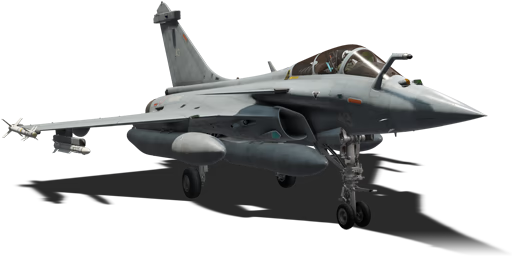
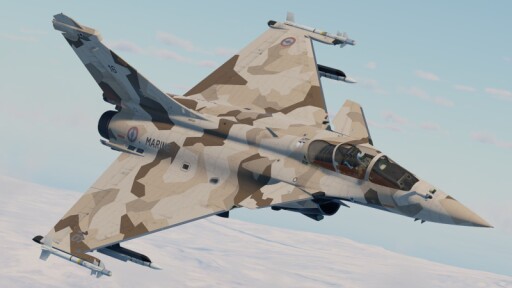
Rafale M F3-R



The Dassault Rafale is a French fourth-generation fighter jet. In the 1970s, the French Navy and Air Force needed a new, multi-role fighter jet capable of performing a wide range of tasks and of being based on aircraft carriers. The French government turned to Dassault Aviation, which had successfully developed the Mirage 2000 fighter jet. In 1983, the Future European Fighter Aircraft (FEFA) program launched, uniting France, Italy, Spain, Germany, and the United Kingdom in the joint development of a new fighter, later known as the Eurofighter Typhoon. However, France left the project in 1985 due to technical disagreements related to design and weaponry requirements.
Dassault continued development independently and launched the first Rafale A prototype in 1986. In addition to the Rafale B and C variants for the Air Force, Dassault created the Rafale M for the French Navy. The Rafale M features a reinforced structure and landing gear, a tail hook, and a built-in ladder for the pilot. The first Rafale M prototype took to the skies on December 12, 1991. However, aircraft carrier trials were not conducted until July 1999. The first production Rafale M aircraft joined the fleet in December 2000, and the aircraft were combat-ready in 2004. In early 2014, the French Ministry of Defense announced funding for the Rafale F3-R modernization program. The upgrade's main objectives were to install a new radar and more advanced communication and surveillance systems, integrate the DAMOCLES targeting pod, and expand the range of weapons. Currently, the French Navy has 42 Rafale M F3-R aircraft in service.
The Rafale M F3-R was introduced in Update 2.53 "Line of Contact". In terms of flight characteristics, the Rafale is one of the best aircraft, competing fiercely for that title with the Eurofighter Typhoon. The aircraft turns well at any speed, conserves energy efficiently, and boasts excellent dynamics and speed. These features are complemented by the powerful Magic 2 and MICA-EM air-to-air missiles. Its wide payload range for engaging ground targets is also impressive. However, compared to the Rafale C, this variant is heavier, and its cannon is difficult to use and has limited ammunition.

flaps
flaps
flaps
brake
| Belt | Belt filling | Armor penetration (mm) at a distance: | |||||
|---|---|---|---|---|---|---|---|
| 10 m | 100 m | 500 m | 1000 m | 1500 m | 2000 m | ||
| SAPHEI | 29 | 27 | 21 | 16 | 11 | 8 | |
| Name | Weight | Slot | ||||||||||||
|---|---|---|---|---|---|---|---|---|---|---|---|---|---|---|
| 89 kg |  | | ||||||||||||
| 112 kg |  | | | | | | | | ||||||
| 2 × | 494 kg |  | | |||||||||||
| 3 × | 741 kg |  | | |||||||||||
| 2 × | 554.3 kg |  | | |||||||||||
| 2 × | 598.7 kg | | | |||||||||||
| 2 × | 554.3 kg | | | |||||||||||
| 495.3 kg |  | | ||||||||||||
| 1,079.6 kg |  | | | |||||||||||
| 3 × | 831.4 kg |  | | |||||||||||
| 3 × | 898.1 kg |  | | |||||||||||
| 3 × | 831.4 kg | | | |||||||||||
| 3 × | 990 kg |  | | |||||||||||
| 3 × | 990 kg |  | | |||||||||||
| 3 × | 990 kg |  | | |||||||||||
| Drop tank (2000 liters) | 116 kg |  | | |||||||||||
| TALIOS targeting pod | 265 kg |  | ||||||||||||
| 670 kg |  | |||||||||||||
| Drop tank (2000 liters) | 116 kg | | ||||||||||||


 Rafale M F3-R
Flight performance | |
|---|---|
Survivability |
|---|
Weaponry | ||
|---|---|---|