
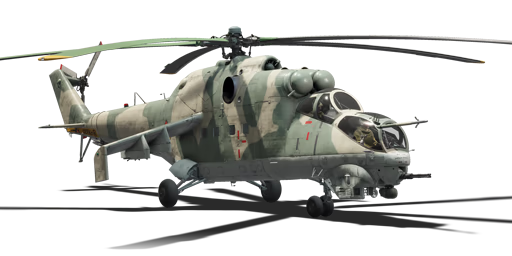
◊Mi-24D




The Mi-24D was a modified version of the Soviet Mi-24A attack helicopter. During the first years of operation, several shortcomings were revealed, including a bad cockpit layout and the low effectiveness of the A-12.7 machine gun. Consequently, the helicopter was given separate tandem cockpits, and the A-12.7 was replaced with a new four-barrel, 12.7 mm YakB machine gun mounted in a remotely controlled turret beneath the operator's position. The new modification was also planned to receive new Shturm-V ATGMs, but their development was delayed. Therefore, in the late 1960s, an interim version of the helicopter was adopted without the new ATGMs. After resolving several issues, the helicopter entered service in 1976 under the designation Mi-24D.
In addition to serving in the USSR, Mi-24D helicopters were exported, including to the Air Forces of the National People's Army. Between 1978 and 1984, the GDR received 42 helicopters, which were mainly used in the country's border regions, including at the Cottbus air base. Three helicopters were lost during service. After German reunification, the Mi-24Ds remained in service with the Bundeswehr for some time. However, from 1993 onwards, they were gradually sold to other countries. Several ended up in museum collections, including one displayed at the Pima Air & Space Museum.
The German Mi-24D was introduced in Update 2.57 "Heavy Cavalry". In battle, the helicopter can be fully loaded with S-5K rocket pods to saturate the battlefield with rockets or carry 250 kg and 500 kg bombs for a risky strike. It can also destroy enemy armoured vehicles from a safe distance with Falanga ATGMs. However, the Mi-24's main drawback is its enormous weight of 12 tons, which negatively affects its flight performance. This weakness is partly offset by its good speed.

| Belt | Belt filling | Armor penetration (mm) at a distance: | |||||
|---|---|---|---|---|---|---|---|
| 10 m | 100 m | 500 m | 1000 m | 1500 m | 2000 m | ||
| AP-I/API-T/AP-I/AP-I/AP-I/AP-I | 29 | 27 | 20 | 13 | 8 | 6 | |
| AP-I/AP-I/IAI/IAI/IAI/API-T | 29 | 27 | 20 | 13 | 8 | 6 | |
| IAI/AP/AP/AP/API-T/AP | 31 | 30 | 22 | 16 | 11 | 8 | |
| IAI/API-T/IAI/IAI/IAI/IAI | 29 | 27 | 20 | 13 | 8 | 6 | |
| Name | Weight | Slot | ||||||
|---|---|---|---|---|---|---|---|---|
| 2 × | 63 kg |  | | |||||
| 32 × | 269.3 kg |  | | | | |||
| 235 kg |  | | | | ||||
| 250 kg |  | | | | ||||
| 94.3 kg |  | | | | ||||
| 478 kg |  | | ||||||


Flight performance |
|---|
Survivability |
|---|
Weaponry | ||
|---|---|---|