
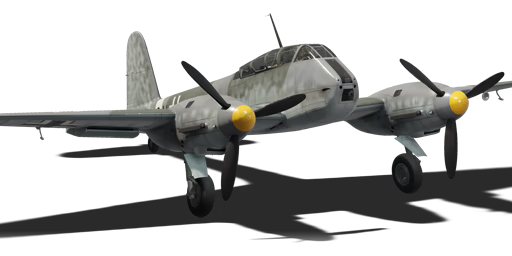



The Messerschmitt Me 210 was a German heavy fighter and ground-attack aircraft. Even before the Bf 110 entered mass production, the German Ministry of Aviation (RLM) began searching for its replacement. In response to this request, Messerschmitt submitted a heavily modified Bf 110, while Arado presented its Ar 240. This modification, the Me 210, featured a redesigned nose for improved visibility, a bomb bay, a unique defensive armament system and a more swept-back wing to enable high cruise speeds. It also had a bomb sight for the pilot. An order for 1,000 aircraft was placed before the prototype's maiden flight. Powered by DB-601B engines, the maiden flight took place on 2 September 1939 and revealed numerous problems with the aircraft: it suffered from poor stability in turns, wobbled even in straight flight and was highly prone to stalling when the automatic leading-edge slats were used. It was precisely due to such a stall that the second prototype was lost.
In an attempt to correct these issues, the designers made several changes: first, the two stabilisers from the Bf 110 were replaced with a single large one, but this did not improve the situation. The tail boom was lengthened and the Me 210 C was fitted with a more powerful DB 605 engine. However, the RLM in Germany was keen to replace the ageing Bf 110s, rushing the Me 210 A-1 into production, which had a short tail and DB 601F engines. By April 1942, these had been delivered to Luftwaffe units, and production halted at 90 aircraft by the end of the month. The Germans also received a number of Hungarian-built Me 210 Cs in 1943. The aircraft saw brief service in Africa and Italy, after which they were replaced by the Me 410.
The Me 210 A-1 was introduced in Update 2.55 "Ninth Wave". The German heavy fighter has several drawbacks: it is slow, has a poor climb rate and maneuvers awfully. Among the aircraft’s strengths are its decent offensive and defense armaments, as well as its bomb bay.

flaps
flaps
flaps
brake
| Belt | Belt filling | Armor penetration (mm) at a distance: | |||||
|---|---|---|---|---|---|---|---|
| 10 m | 100 m | 500 m | 1000 m | 1500 m | 2000 m | ||
| IT/IT/APHE/HEI | 20 | 18 | 10 | 5 | 4 | 4 | |
| IT/HEI/HEI/AP-I | 27 | 24 | 14 | 7 | 3 | 2 | |
| AP-I/HEI/HEI/HEI/HEI/IT | 27 | 24 | 14 | 7 | 3 | 2 | |
| APHE/APHE/APHE/IT | 20 | 18 | 10 | 5 | 4 | 4 | |
| FI-T/FI-T/FI-T/IT/IT | 10 | 9 | 5 | 3 | 2 | 1 | |
| HEI/HEI/HEI/APHE/AP-I | 27 | 24 | 14 | 7 | 3 | 2 | |
| Belt | Belt filling | Armor penetration (mm) at a distance: | |||||
|---|---|---|---|---|---|---|---|
| 10 m | 100 m | 500 m | 1000 m | 1500 m | 2000 m | ||
| AP-T/AP-I/AI | 9 | 8 | 6 | 3 | 0 | 0 | |
| AP-T/AP/AI/AP-I | 13 | 12 | 7 | 3 | 2 | 0 | |
| AP-T | 9 | 8 | 6 | 3 | 0 | 0 | |
| AI/AP/AP/AP/AI | 13 | 12 | 7 | 3 | 2 | 0 | |
| Belt | Belt filling | Armor penetration (mm) at a distance: | |||||
|---|---|---|---|---|---|---|---|
| 10 m | 100 m | 500 m | 1000 m | 1500 m | 2000 m | ||
| IT/AP-I/IAI/AP-I | 19 | 16 | 8 | 4 | 2 | 1 | |
| AP-T/AP-T/AP-T/IAI | 19 | 16 | 8 | 4 | 2 | 1 | |
| Name | Weight | Slot | ||||
|---|---|---|---|---|---|---|
| 50 kg |  | | | | ||
| 8 × | 400 kg |  | ||||
| 2 × | 500 kg |  | ||||
| 500 kg |  | |||||
| 988 kg |  | |||||


Flight performance | |
|---|---|
Survivability |
|---|
Weaponry | ||
|---|---|---|