
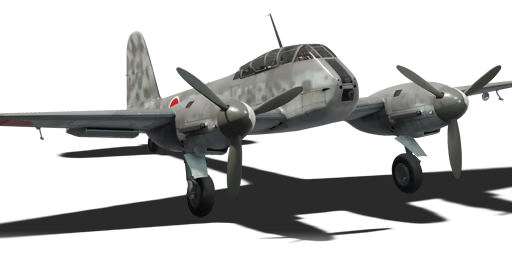



The Messerschmitt Me 210 was a German heavy fighter and ground attack aircraft. Developed in the late 1930s, it was intended as a replacement for the Bf 110, which was still a prototype at the time. The new aircraft featured an unusual cockpit, a bomb bay, and a defensive armament system with wide angles of attack. It was also designed to have a high cruising speed. The aircraft made its maiden flight on September 2, 1939, and deliveries to units began in April 1942. However, the aircraft had numerous problems. In particular, it was prone to stalling, generally unstable in flight, and lacked sufficient engine power. Consequently, only 94 pre-production aircraft were built in Germany, and German Me 210A-1s remained in service only briefly before being replaced by the Me 410.
For research purposes, one Me 210 V22 was transported to Japan by submarine in January 1943. This prototype, bearing the tail number GE+KV, had previously undergone testing in Rechlin in 1942 to improve the aircraft’s flight characteristics. This is why it features an elongated fuselage. The Me 210 arrived in disassembled form and was assembled by Kawasaki. It then underwent testing by the Imperial Japanese Army Air Force. However, it failed to impress the military. To make matters worse, the aircraft sustained damage to the landing gear and engine mounts. Subsequently, Kawasaki used the plane for own tests.
The Japanese Me 210 V22 was introduced in Update 2.55 "Ninth Wave". Despite minor design changes, the Japanese aircraft is not significantly better than the German Me 210 and has the same drawbacks: it is slow, has a poor climb rate and maneuvers awfully. Among the aircraft’s strengths are its decent offensive and defense armaments, as well as its bomb bay.

flaps
flaps
flaps
brake
| Belt | Belt filling | Armor penetration (mm) at a distance: | |||||
|---|---|---|---|---|---|---|---|
| 10 m | 100 m | 500 m | 1000 m | 1500 m | 2000 m | ||
| IT/IT/APHE/HEI | 20 | 18 | 10 | 5 | 4 | 4 | |
| IT/HEI/HEI/AP-I | 27 | 24 | 14 | 7 | 3 | 2 | |
| AP-I/HEI/HEI/HEI/HEI/IT | 27 | 24 | 14 | 7 | 3 | 2 | |
| APHE/APHE/APHE/IT | 20 | 18 | 10 | 5 | 4 | 4 | |
| FI-T/FI-T/FI-T/IT/IT | 10 | 9 | 5 | 3 | 2 | 1 | |
| HEI/HEI/HEI/APHE/AP-I | 27 | 24 | 14 | 7 | 3 | 2 | |
| Belt | Belt filling | Armor penetration (mm) at a distance: | |||||
|---|---|---|---|---|---|---|---|
| 10 m | 100 m | 500 m | 1000 m | 1500 m | 2000 m | ||
| AP-T/AP-I/AI | 9 | 8 | 6 | 3 | 0 | 0 | |
| AP-T/AP/AI/AP-I | 13 | 12 | 7 | 3 | 2 | 0 | |
| AP-T | 9 | 8 | 6 | 3 | 0 | 0 | |
| AI/AP/AP/AP/AI | 13 | 12 | 7 | 3 | 2 | 0 | |
| Belt | Belt filling | Armor penetration (mm) at a distance: | |||||
|---|---|---|---|---|---|---|---|
| 10 m | 100 m | 500 m | 1000 m | 1500 m | 2000 m | ||
| IT/AP-I/IAI/AP-I | 19 | 16 | 8 | 4 | 2 | 1 | |
| AP-T/AP-T/AP-T/IAI | 19 | 16 | 8 | 4 | 2 | 1 | |
| Name | Weight | Slot | ||||
|---|---|---|---|---|---|---|
| 50 kg |  | | | | ||
| 8 × | 400 kg |  | ||||
| 2 × | 500 kg |  | ||||
| 500 kg |  | |||||
| 988 kg |  | |||||

 2 x (60 / 125 / 255) %
2 x 136 %
2 x (60 / 125 / 255) %
2 x 136 %
Flight performance | |
|---|---|
Survivability |
|---|
Weaponry | ||
|---|---|---|