Loire 130C

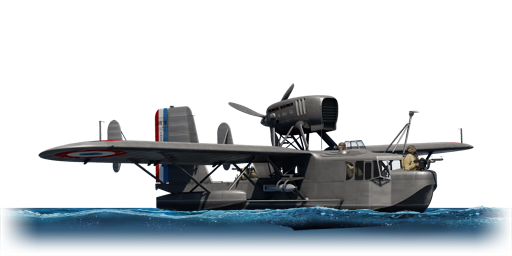
In the mid-1930s, the French Navy announced a competition to design a reconnaissance seaplane for its cruisers and battleships. Six companies responded in 1936, presenting the Bréguet 610, Gourdou-Leseurre GL-820 HY, Levasseur PL.200, CAMS 120, and Loire 130 aircraft. The Loire 130 was selected as the winner due to its characteristics. Serial production began in 1937, and two types of the aircraft were produced: the Loire 130M, the standard version, and the Loire 130C, a colonial model with an enlarged radiator and a Hispano-Suiza 12Ycrs engine. A total of 125 aircraft of both types were built. By the end of the 1930s, almost all French ships used the Loire 130, including the seaplane carrier Commandant Teste. Many seaplanes survived the German invasion in 1940 and were used by France in various roles until 1951.
The Loire 130C was introduced in Update 2.27 "La Royale". The aircraft has relatively average flight characteristics, and unlike many other catapult planes, it has some armament. It is armed with two turrets containing 7.5 mm machine guns that cover the front and rear hemispheres. It also carries two 75 kg bombs, which are enough to sink a distracted coastal boat. However, compared to other planes the Loire 130C faces, the aircraft is a slow and easy target.

flaps
flaps
flaps
brake
control
| Belt | Belt filling | Armor penetration (mm) at a distance: | |||||
|---|---|---|---|---|---|---|---|
| 10 m | 100 m | 500 m | 1000 m | 1500 m | 2000 m | ||
| T/Ball/Ball/I/AP | 13 | 12 | 7 | 3 | 2 | 0 | |
| T/AP/AP/AP | 13 | 12 | 7 | 3 | 2 | 0 | |
| T/AP | 13 | 12 | 7 | 3 | 2 | 0 | |