
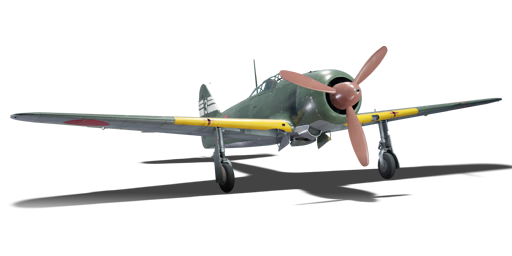
Ki-100-II



The Kawasaki Ki-100-II was a high-altitude version of the Japanese Ki-100 fighter. The Ki-100, while generally successful, was an improvised solution to the Imperial Japanese Army Air Force's shortage of modern fighters. However, to effectively counter American B-29 Superfortress bomber formations, specialised interceptors capable of operating at high altitudes were required. Therefore, in March 1945, Kawasaki began developing a dedicated high-altitude version of the Ki-100 fighter, which featured a modified Mitsubishi Ha-112-II Ru engine with a water-methanol injection system and a turbocharger. However, this upgraded Ki-100 never entered production – Japan was defeated, and only three prototypes were built.
The Ki-100-II was introduced in Update 1.65 "Way of the Samurai". Compared to the base Ki-100, this version of the fighter is characterised by improved high-altitude performance, at the cost of reduced speed and manoeuvrability at low and medium altitudes. It truly shines at altitudes of 8–10 km, where dogfights are rare. However, the Ki-100-II still retains well-balanced flight characteristics. Thanks to its decent top speed, climb rate, and manoeuvrability, it can compete with many opponents in aerial combat, and its powerful forward-firing armament, by Japanese standards, allows it to destroy both single-engine fighters and more durable four-engine bombers with ease.

flaps
flaps
flaps
brake
| Belt | Belt filling | Armor penetration (mm) at a distance: | |||||
|---|---|---|---|---|---|---|---|
| 10 m | 100 m | 500 m | 1000 m | 1500 m | 2000 m | ||
| HEF-I/P/AP-T | 27 | 25 | 17 | 10 | 6 | 4 | |
| HEF-I/HEF-I/AP-T | 27 | 25 | 17 | 10 | 6 | 4 | |
| AP-T/AP-T/HEF-I | 27 | 25 | 17 | 10 | 6 | 4 | |
| AP-T | 27 | 25 | 17 | 10 | 6 | 4 | |
| HEF-I/HEF-I/HEF-I/P | 16 | 13 | 8 | 6 | 0 | 0 | |
| Belt | Belt filling | Armor penetration (mm) at a distance: | |||||
|---|---|---|---|---|---|---|---|
| 10 m | 100 m | 500 m | 1000 m | 1500 m | 2000 m | ||
| AP-T/AP/HEF-I | 21 | 19 | 13 | 7 | 4 | 3 | |
| AP-T/HEF-I/AP/HEF-I | 21 | 19 | 13 | 7 | 4 | 3 | |
| AP-T/HEF-I/HEF-I/HEF-I | 21 | 19 | 13 | 7 | 4 | 3 | |
| AP-T/AP/AP-T | 21 | 19 | 13 | 7 | 4 | 3 | |
| AP/HEF-I/HEF-I/HEF-I | 21 | 19 | 13 | 7 | 4 | 3 | |

 2 x (55 / 175 / 275) %
2 x 136 %
2 x (55 / 175 / 275) %
2 x 136 %
Flight performance | |
|---|---|
Survivability |
|---|
Weaponry | ||
|---|---|---|